What Is Grey Zone Warfare? Strategy, Tactics and Modern State Conflict
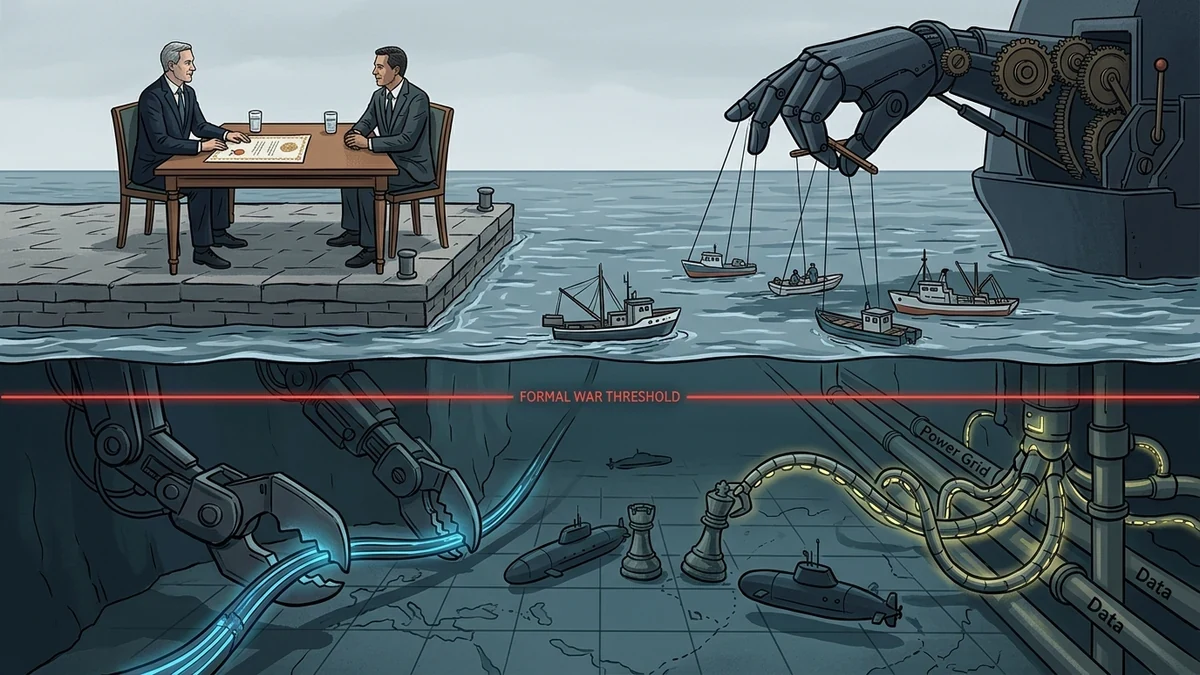
Grey zone warfare is a strategy of cumulative coercion designed to achieve revisionist political and territorial objectives while deliberately remaining below an adversary's formal threshold for conventional military retaliation. States weaponize cyber intrusions, commercial lawfare, maritime militias, covert proxy forces, and critical infrastructure disruption to fragment defensive decision loops and alter the status quo without triggering open armed conflict.
Executive Assessment & Epistemic Frame
Executive Assessment: Grey zone warfare is not a separate category of conflict but a strategy of cumulative coercion designed to achieve political objectives while remaining below an adversary's threshold for conventional military retaliation. States employ cyber operations, economic coercion, maritime harassment, disinformation, proxy forces, legal warfare, and infrastructure pressure to fragment decision-making and impose strategic costs without triggering formal war.
Analytical Confidence: HIGH | Cross-theater empirical verification across the South China Sea, Baltic maritime corridors, and Taiwan Strait demonstrates uniform structural reliance on sub-threshold operational ambiguity.
Key Uncertainty: The exact threshold at which accumulated grey-zone actions trigger conventional military retaliation varies significantly by adversary risk tolerance, domestic political cohesion, and alliance treaty ambiguity.
State-backed actors continuously conduct un-attributed cyber reconnaissance, subsea cable physical interference, maritime militia blockades, and coercive trade embargoes without formally declaring war or initiating kinetic combat.
These disparate tactical actions are not isolated incidents but integrated instruments of a deliberate grand strategy aimed at shifting the territorial, economic, and institutional balance of power while denying defenders a clear casus belli.
Defenders structured solely around conventional high-end kinetic deterrence risk strategic defeat through incremental exhaustion, as adversaries achieve their strategic aims without ever providing justification for a major military response.
1. What Is Grey Zone Warfare? Taxonomy & Definitional Boundaries
Grey zone warfare occupies the contested operational space between routine diplomatic/economic competition and open, industrialized armed conflict. It is characterized by three core pillars: ambiguity of attribution, sub-threshold operational calibration, and cumulative strategic intent.
Unlike conventional warfare—which seeks decisive battlefield destruction through direct armed clashes—grey zone strategy seeks to exhaust an adversary's political resolve, degrade institutional trust, and alter strategic geography incrementally over multi-year horizons (often described in strategic literature as "salami slicing").
The Conflict Spectrum: Operational Typology
To analyze grey zone operations effectively, intelligence analysts must distinguish between the five distinct phases of inter-state interaction:
| Operational Activity | Peace | Competition | Grey Zone | Hybrid Warfare | Conventional War |
|---|---|---|---|---|---|
| Diplomatic Maneuvering & Trade Talks | ✓ | ✓ | ✓ | ✓ | — |
| State-Sponsored Cyber Espionage | — | ✓ | ✓ | ✓ | ✓ |
| Economic Coercion & Lawfare | — | — | ✓ | ✓ | ✓ |
| Maritime Militia & Shadow Fleets | — | — | ✓ | ✓ | ✓ |
| Critical Infrastructure Sabotage (Subsea/Grid) | — | — | ✓ | ✓ | ✓ |
| Covert Proxy Ground Operations | — | — | ✓ | ✓ | ✓ |
| Declared Military Blockade | — | — | — | ✓ | ✓ |
| Open Kinetic Invasion & Air Strikes | — | — | — | — | ✓ |
2. The Seven Strategic Instruments of Grey Zone Conflict
Grey zone warfare does not rely on a single weapon system; rather, it coordinates seven distinct non-kinetic and sub-threshold vectors into a synchronized campaign of strategic attrition:
A. Cognitive & Information Warfare (Infrastructure & Synthetic Saturation)
Adversaries deploy automated botnets, generative AI personas, and covert media funding to amplify societal polarization, paralyze democratic consensus, and undermine public trust in national defense institutions. In modern tradecraft, social media forensics and Social Media Intelligence (SOCMINT) reveal how state APTs systematically map civilian digital behavior to seed divisive narratives ahead of political elections. Furthermore, as demonstrated in our strategic analysis of simultaneous AI outages and the cognitive chokepoint, multi-platform latency saturation and synthetic attribution cascades can paralyze institutional decision-making loops without requiring kinetic intervention.
B. Offensive Cyber Intrusion & Infrastructure Pre-Positioning
Rather than executing high-visibility destructive wiper attacks, state-sponsored cyber units (such as China's Volt Typhoon or Russia's Sandworm) focus on deep, persistent pre-positioning inside operational technology (OT) networks. As explored in our assessment of machine-speed zero-day discovery, automated cyber exploitation allows adversaries to quietly compromise substation switchgear and port control systems months before a diplomatic crisis erupts.
C. Economic Lawfare & Commercial Coercion
Economic coercion leverages trade dependencies, critical mineral supply bottlenecks, and commercial legal mechanisms as instruments of sovereign force. In high-stakes maritime scenarios, adversaries weaponize maritime reinsurance and shipping guarantees—an operational vector detailed in our analysis of commercial lawfare as deterrence—to effectively halt commercial traffic to an island democracy without deploying a single warship.
D. Maritime Coercion & Shadow Fleet Operations
In maritime chokepoints, revisionist powers deploy non-military vessels—such as China's People's Armed Forces Maritime Militia (PAFMM) or Russian dark tankers manipulating AIS transponders—to enforce illegal territorial claims. In the South China Sea, the PAFMM deploys reinforced steel-hulled trawlers alongside China Coast Guard (CCG) cutters equipped with 60-bar high-pressure water cannons, ramming and blockading Philippine resupply operations at Second Thomas Shoal (9°48′N 115°51′E). By using ostensibly civilian fishing fleets to ram foreign vessels, as examined in our investigation of Baltic subsea cable tracking, attackers create a high-friction environment that paralyzes naval rules of engagement and deliberately denies defenders an Article 5 collective defense trigger.
E. Deniable Proxy Warfare
States project violent coercive force while avoiding sovereign accountability by outsourcing kinetic tasks to private military companies (PMCs), paramilitary groups, or local insurgencies. This creates an epistemic barrier: defenders know the origin of the aggression, but the formal evidentiary bar required to justify retaliatory strikes remains legally ambiguous.
F. Critical Infrastructure Sub-Threshold Sabotage & Attribution Friction
Attacking civil infrastructure below the kinetic threshold creates acute systemic strain without presenting a single clear target. As detailed in our foundational guide on critical infrastructure vulnerabilities and our deep dive on the attribution trap and airport drone swarms, un-attributed sabotage against power distribution lines, airport airspaces, and wastewater SCADA systems imposes severe domestic friction and legal paralysis on defenders while attackers maintain complete deniability.
Recent verified incidents in the Baltic Sea illustrate this physical friction: the Hong Kong-flagged container ship NewNew Polar Bear severed the Balticconnector gas pipeline and telecom links with a dragged 6-ton anchor, while the Chinese bulk carrier Yi Peng 3 dragged its anchor over 180 kilometers across the seafloor, severing the C-Lion1 (Finland-Germany) and BCS East-West (Lithuania-Sweden) fiber-optic cables. Concurrently, pervasive GPS and GNSS spoofing across the Suwalki Gap and Gulf of Finland disrupted over 46,000 commercial flights, illustrating how civilian infrastructure is systematically leveraged for sub-threshold state coercion.
As revisionist states integrate autonomous generative AI and multi-agent coordination frameworks into hybrid operations, grey zone conflict is increasingly accelerated by agentic warfare and autonomous cognitive operations, compressing decision cycles from days to milliseconds and automating non-linear escalation across digital and physical battlegrounds.
G. Normative & Institutional Lawfare
Adversaries systematically exploit international legal bodies, multilateral standard-setting agencies (such as the ITU), and regional arbitration forums to redefine maritime boundaries, airspace designations, and sovereignty norms. By flooding international institutions with competing legal interpretations, states create a veneer of legitimacy for their territorial expansion.
3. The Strategic Paradox: The Defender's Threshold Dilemma
The core strategic power of grey zone warfare lies in the Defender's Dilemma. When an adversary seizes an isolated coral reef with fishing vessels, disables a regional power transformer with malware, or cuts a subsea fiber cable with an anchor drag, the targeted state faces an impossible choice:
- Option A (Kinetic Escalation): Responding with lethal military force (such as sinking the militia boat or launching airstrikes on the origin base) appears disproportionate, internationally reckless, and risks triggering catastrophic general war.
- Option B (Non-Kinetic Inaction): Issuing diplomatic demarches or imposing minor sanctions concedes the physical or digital ground, normalizing the adversary's gains and inviting the next phase of sub-threshold expansion.
Over time, this dynamic produces cumulative exhaustion. The defender's deterrence architecture—built for high-intensity, industrial-scale conflict—proves structurally unsuited for countering continuous micro-aggressions that individually fall below the threshold of Article 5 or formal defense pact activations.
4. Modern Flashpoints: Where Grey Zone Warfare Operates Today
1. The South China Sea & Second Thomas Shoal
China's deployment of coast guard water cannons, acoustic weapons, and hundreds of maritime militia vessels to blockade Philippine outposts without firing a single bullet demonstrates master-class grey zone tactical calibration.
2. The Baltic Sea & Undersea Infrastructure
Repeated anchor-dragging incidents severing telecom cables and gas pipelines (Nord Stream, Balticconnector, Estlink) represent physical sabotage disguised as commercial navigation mishaps in international waters.
3. The Taiwan Strait Quarantine Doctrine
Rather than launching a bloody amphibious assault across the strait—countered by autonomous AI drone swarms—Beijing's grey-zone strategy models customs inspections, air-defense zone saturation, and sovereign reinsurance cancellations to slowly strangle Taiwan's economy.
5. Strategic Countermeasures: How Democracies Can Deter the Grey Zone
Defeating grey zone operations requires moving beyond legacy deterrence-by-punishment doctrines toward comprehensive, agile counter-coercion frameworks:
- Accelerate Attribution Velocity: Grey zone actors rely on deniability to create political hesitation. By leveraging commercial satellite radar (SAR), automated telemetry, and open-source intelligence (OSINT) to publicly expose covert operations within hours, defenders eliminate the adversary's information shield.
- Cross-Domain Asymmetric Retaliation: Defenders must establish clear doctrine signaling that sub-threshold attacks in one domain (e.g., cyber sabotage) will trigger immediate, severe retaliatory penalties in another (e.g., financial asset freezes or export bans on sovereign AI compute hardware).
- Harden Civil & Industrial Resilience: Physical security for subsea interconnectors, zero-trust architectures for water and energy SCADA systems, and sovereign backup logistics reduce the operational yield of grey-zone sabotage.
⚡ The ICS Strategic Briefing — Intelligence Dispatch
Stay ahead of sub-threshold escalation. Receive weekly executive intelligence assessments tracking grey-zone sabotage, maritime militia incursions, and critical infrastructure telemetry delivered directly to your inbox.
Expert Analysis — Bhanu Pratap Meena
"Founder & Hybrid Warfare Specialist: Strategic intelligence assessments in the Regional Conflict Evaluations arena indicate shifting operational dynamics. The technical telemetry and incident vectors analyzed here reveal calculated adjustments by state and non-state actors to exploit structural vulnerabilities before defensive countermeasures can be deployed. Continuous technical and geospatial verification remains paramount."
Related Domain Analysis: Explore our coverage of Geopolitics & Strategy.
Topical Bibliography & References
- Center for Strategic and International Studies (CSIS) (2024). "By Other Means: The Evolution and Strategic Function of Grey Zone Conflict" CSIS International Security Program. [Source Link ↗]
- International Institute for Strategic Studies (IISS) (2025). "Sub-Threshold Coercion and the Dilemmas of Deterrence in the Indo-Pacific and Baltic" Survival: Global Politics and Strategy. [Source Link ↗]
- Royal United Services Institute (RUSI) (2026). "The Strategic Logic of the Grey Zone: Hybrid Threats, Plausible Deniability, and Legal Asymmetry" RUSI Occasional Papers. [Source Link ↗]
Key Takeaways
- Grey zone warfare operates in the contested space between peace and open armed conflict, exploiting legal ambiguities, attribution deficits, and political hesitation.
- The strategy relies on 'salami slicing'—accumulating small, incremental tactical gains that individually do not justify a military response, but collectively alter the regional balance of power.
- The seven core instruments of grey zone conflict span information warfare, state cyber pre-positioning, economic lawfare, maritime grey fleets, proxy forces, critical infrastructure stress, and normative institutional capture.
- Defenders face the 'Response Dilemma': conventional military retaliation appears disproportionate and escalatory, while non-response concedes continuous strategic ground.
- Deterring grey zone operations requires proactive attribution velocity, cross-domain counter-coercion, sovereign infrastructure hardening, and multilateral threshold alignment.
Need a Deeper Operational or Threat Assessment?
International Conflict Studies provides custom open-source intelligence dossiers, geopolitical risk modeling, and critical infrastructure threat diagnostics for enterprise and sovereign decision-makers.
Frequently Asked Questions: Gray Zone Conflict & Sub-Threshold Strategy
Operational Q&A: Deciphering the Grey Zone
- Maritime Militia Swarms: Deploying state-funded fishing trawlers and coast guard cutters to block maritime transit and establish sovereign control without deploying naval warships.
- Subsea Infrastructure Sabotage: Severing submarine fiber-optic cables and subsea gas interconnectors under the guise of commercial maritime accidents (e.g. anchor dragging).
- SCADA Cyber Pre-Positioning: Infiltrating civilian electrical grids, water treatment plants, and port logistics software (such as Volt Typhoon intrusions).
- Electronic Warfare & GNSS Spoofing: Jamming commercial aviation and maritime GPS transponders across border corridors to induce navigation hazards and military friction.
- Agentic Cognitive Operations: Mobilizing autonomous AI agent swarms to execute continuous information manipulation and polarize target populations.
Does your enterprise or policy team encounter sub-threshold coercion, deniable proxy operations, or cognitive influence campaigns? International Conflict Studies delivers corporate security training, threat actor profiling, and red-teaming simulations to protect critical operations from hybrid conflict.
Explore Corporate & Security Training Modules →
Analytical Feedback & Discussion
Share your analytical observations, ask questions, or contribute regional telemetry regarding this briefing.