The Architecture of Survival: What Is Critical Infrastructure, Why It Fails, and Why Disconnection Is an Illusion
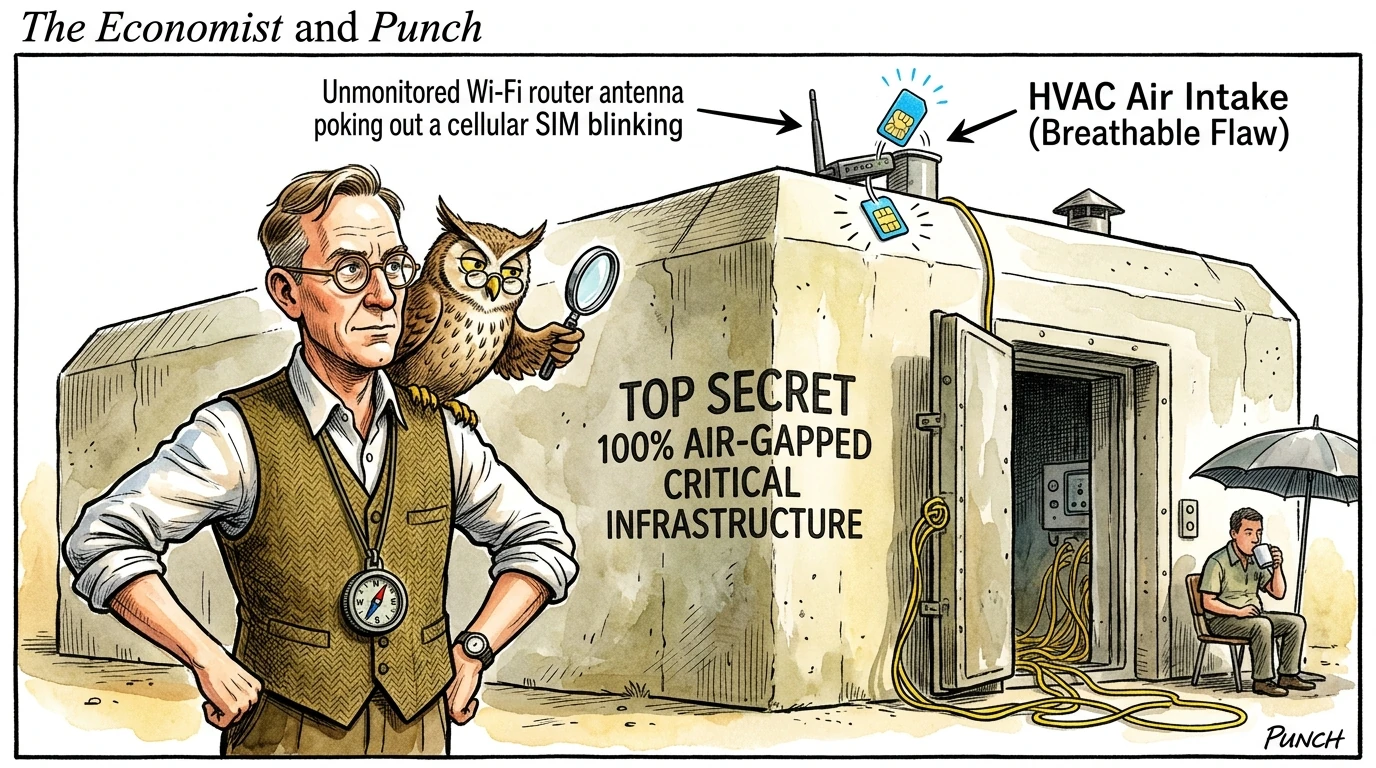
Modern sovereign security is determined by the physical resilience and digital opacity of critical infrastructure. In an anarchic international system, adversary states prioritize sub-threshold grey-zone sabotage—penetrating unmonitored maintenance ports, severing subsea communication cables, and targeting ventilation vulnerabilities in hardened bunkers—over conventional kinetic confrontation.
Critical infrastructure encompasses the physical assets, digital control networks, logistical conduits, and organizational supply chains deemed so vital to a sovereign state that their incapacitation or destruction would exert a debilitating impact on national security, economic prosperity, public health, or basic societal survival.
1. The Biological Anatomy of a Sovereign State
To understand critical infrastructure intuitively, analyze a sovereign nation through the lens of human anatomy:
- The Electric Power Grid is the Bloodstream: It continuously pumps high-voltage energy to every municipal organ, manufacturing center, and hospital.
- Critical Communication Infrastructure is the Central Nervous System: Subsea fiber cables, micro-wave relays, and satellite downlinks carry command-and-control signals, banking ledgers, and government decisions.
- Water Treatment & Food Distribution Networks are the Digestive System: They sustain biological life, agricultural yield, and basic urban hygiene.
- Defense Industrial Facilities & Fortified Military Shelters are the Immune System: They repel external predators, intercept incoming strikes, and preserve retaliatory deterrence.
If any of these foundational systems suffer catastrophic disruption, modern urban civilization does not degrade gradually; it experiences systemic failure within 48 to 72 hours.
2. Core Categories: The Five Strategic Pillars
In national security doctrine, critical infrastructure is structured into five interdependent strategic domains:
- ⚡ Energy & Power Grids: Nuclear reactors, hydroelectric dams, natural gas compressor stations, high-voltage step-up transformers (345kV–765kV), and commercial grid-balancing battery storage facilities.
- 📡 Critical Communication Infrastructure: Undersea submarine fiber-optic cables (which transmit over 95% of international internet data and $10+ trillion in daily financial transactions), 5G core cellular routing nodes, satellite telemetry ground stations, and sovereign cloud data centers.
- 🛡️ Defense Industrial Base & Hardened Facilities: Munitions assembly plants, early-warning over-the-horizon radar arrays, command bunkers, and Hardened Aircraft Shelters (HAS).
- 🚰 Water, Agriculture & Public Health: Pressurized municipal potable water distribution reservoirs, wastewater chemical treatment facilities, bulk grain storage elevators, and specialized trauma care hospitals.
- 💳 Financial Infrastructure & Maritime Chokepoints: Central bank real-time gross settlement (RTGS) networks, interbank SWIFT messaging relays, automated container port crane operating systems, and rail interlocking switches.
3. The Realist Reality: Why Infrastructure Dictates Geopolitics
In structural realist international relations theory, the global system is anarchic—lacking an overarching supreme authority to enforce peace. Consequently, sovereign states exist in a state of continuous self-help, where power, leverage, and national survival dictate behavior.
During peacetime, civilian populations view infrastructure as mundane public utilities. In modern grey-zone and hybrid warfare, however, infrastructure is the primary battlespace. Hostile states rarely launch costly frontal assaults against heavily fortified conventional military formations when they can asymmetrically achieve political coercion by disabling an adversary's domestic electrical grid, cutting international internet cables, or contaminating water distribution telemetry.
Systemic Cascading Failure Rule: Grid Blackout → Water Pumps Halt → Cellular Towers Drain Batteries → Financial Clearing Halts → Civil Order Breaks. Within 72 hours of a total grid blackout, fuel pumps cannot dispense diesel to emergency convoys, refrigerated medical stockpiles spoil, and emergency communications collapse.
4. The Core Vulnerabilities: Why the Fortress Always Leaks
The "Texting Your Ex" Paradox (The Air-Gap Myth)
The single most pervasive and lethal misconception in industrial cybersecurity is the doctrine of the "air-gapped system"—the belief that critical industrial machinery is physically isolated from the public internet and therefore immune to external intrusion.
In practice, operational technology exhibits what security engineers call the "Texting Your Ex" paradox. A person may adamantly declare they have entered "zero contact" with a former partner, yet they leave an unmonitored secondary messaging app installed, check mutual Spotify playlists, or hide a spare key under the front porch mat.
Critical infrastructure operators fall into this exact psychological trap: to avoid dispatching human technicians in severe weather to check a remote mountain backup generator, a contractor quietly installs an unmonitored 4G/5G cellular router. That single unmonitored backdoor leaves heavy industrial machinery exposed directly to hostile offensive cyber actors operating thousands of miles away.
Legacy Operational Technology (OT) & SCADA Fragility
Unlike enterprise IT networks that receive regular software patches, Operational Technology (OT) networks controlling municipal water pumps and power plants rely on SCADA systems and PLCs built decades ago. Many of these industrial protocols (e.g., Modbus, DNP3, Profibus) were engineered without native cryptographic authentication or password encryption, operating on the dangerous assumption that physical perimeter security would prevent unauthorized access.
Physical Single Points of Failure (High-Voltage Transformers)
Sovereign power grids are structurally bottlenecked by massive, custom-manufactured Large Power Transformers (LPTs). These multi-ton units require specialized heavy-forging facilities and carry procurement lead times ranging between 18 and 36 months. The physical destruction or electronic burnout of fewer than ten critical substation transformers in any major economy could trigger a multi-regional blackout lasting several years.
5. Real-World Case Studies in Modern Conflict
1. The Cyber Vector: State-Sponsored Infiltration of Backup Power Generators
In recent European threat advisories, intelligence agencies identified coordinated reconnaissance campaigns by Iranian-aligned Advanced Persistent Threat (APT) units targeting municipal emergency infrastructure across the United Kingdom and continental Europe. Attackers systematically scanned open internet space for cellular-connected management ports on backup diesel generators situated at water pumping stations and hospital campuses, allowing them to remotely alter voltage regulation loops, drain fuel lines, or trip cooling sensors.
2. The Kinetic Vector: Precision Standoff Munitions Piercing HAS Ventilation Ducts
Military airbases across contested frontiers feature reinforced Hardened Aircraft Shelters (HAS) constructed with multi-meter-thick steel-reinforced concrete arches designed to deflect ballistic shockwaves. However, all enclosed military facilities share an inescapable thermodynamic constraint: they require ventilation to breathe. Modern precision-guided standoff munitions do not attempt to punch through the thickest concrete dome; terminal guidance algorithms route the weapon directly into the unarmored ventilation intake louvers, detonating internally to generate catastrophic blast overpressure.
3. The Maritime Vector: Subsea Fiber-Optic Cable Severance
In the Baltic Sea and the maritime approaches to Taiwan, grey-zone hybrid warfare has manifested in repeated disruptions to submarine communication cables. Commercial cargo vessels and "dark fleet" fishing trawlers have repeatedly dragged commercial-grade anchors across mapped seabed cable corridors for tens of kilometers, cutting dual telecommunications conduits while maintaining plausible deniability as accidental navigational mishaps.
4. The Cognitive & Cloud Vector: Hyperscale Compute Saturation
As documented in our strategic assessment of the cognitive chokepoint and simultaneous AI outages, critical infrastructure no longer resides solely in copper and concrete. Centralized inference gateways, edge CDN routing, and silicon accelerator monocultures represent single points of failure that can paralyze real-time security operations and crisis triage when subjected to distributed routing friction or hardware exploits.
6. How OSINT, SOCMINT & Humanitarian Intelligence Expose Weaknesses
Vulnerability discovery is no longer the exclusive monopoly of sovereign spy agencies. The convergence of open-source intelligence (OSINT), social media intelligence (SOCMINT), and commercial geospatial telemetry allows independent researchers to map critical nodes openly:
- Network Infrastructure OSINT: Distributed search engines such as Shodan and Censys continuously catalog internet-facing IPv4/IPv6 addresses, exposing unauthenticated SCADA controllers, water filtration valves, and industrial camera feeds.
- Social Media Intelligence (SOCMINT): Maintenance contractors routinely publish workplace photos on LinkedIn and Instagram, inadvertently revealing control-room panel schematics and software version numbers.
- Humanitarian Intelligence & BDA: Open-source conflict monitors utilize commercial Synthetic Aperture Radar (SAR) satellite constellations and thermal-anomaly sensors to verify structural damage to civilian electrical distribution grids and water purification reservoirs during armed conflicts.
7. Dr. Chokepoint & Radar the Owl: Strategic Realist Takeaway
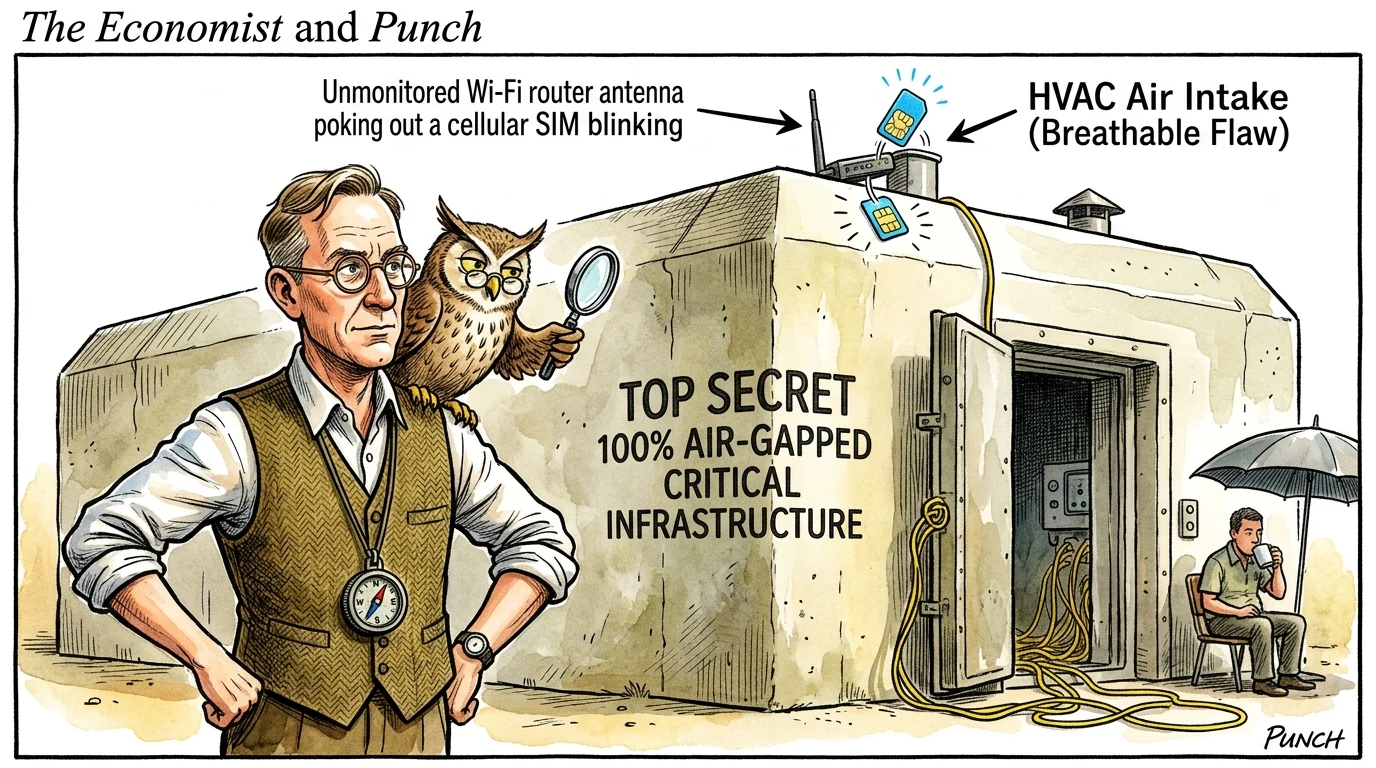
🎩 Dr. Chokepoint Analysis: "The most catastrophic strategic error a military or civilian planner can make is assuming that physical concrete or disconnected network cables create invulnerability. In the physics of conflict, everything that breathes oxygen requires a duct; everything that operates efficiently requires a data link. In an anarchic world, true sovereignty belongs not to the nation with the thickest bunker walls, but to the state that engineers redundancy and assumes every perimeter is already compromised."
🦉 Radar's Cynical Take: "An air gap is just a cable you haven't discovered yet. If an industrial pump has a power cord, someone somewhere has connected it to Wi-Fi to save a five-minute walk in the rain."
8. Strategic Hardening: Moving to Zero-Trust Critical Infrastructure
To counter the reality of constant grey-zone probing and sub-threshold sabotage, modern defense and civil infrastructure must implement four zero-trust hardening mandates:
- Strict Physical Backdoor Elimination: Conduct comprehensive physical radio-frequency (RF) sweeps across all substations and generator facilities to eliminate unauthorized cellular dongles installed by third-party contractors.
- Blast-Attenuating Ventilation Baffles: Retrofit hardened military aircraft shelters and command bunkers with serpentine blast-attenuation baffles and reinforced heavy-steel intake grilles.
- National Large Power Transformer (LPT) Strategic Reserve: Establish government-backed strategic stockpiles of modular high-voltage step-up transformers to compress replacement lead times from two years to under 14 days.
- Seabed Acoustic & AIS Cable Sentry Monitoring: Deploy autonomous underwater hydrophone arrays along high-density submarine cable landing zones to detect illegal anchor dragging and clandestine seabed submersibles in real time.
Expert Analysis — Bhanu Pratap Meena
"Founder & Hybrid Warfare Specialist: Strategic intelligence assessments in the Critical Infrastructure Vulnerabilities arena indicate shifting operational dynamics. The technical telemetry and incident vectors analyzed here reveal calculated adjustments by state and non-state actors to exploit structural vulnerabilities before defensive countermeasures can be deployed. Continuous technical and geospatial verification remains paramount."
Related Domain Analysis: Explore our coverage of Hybrid Warfare & Cyber Security.
Topical Bibliography & References
- Jacquelyn Schneider (2023). "The Strategic Dynamics of Subsea Cable Security and Grey-Zone Interdiction" Journal of Strategic Studies. [Source Link ↗]
- Kim Zetter (2014). "Countdown to Zero Day: Stuxnet and the Launch of the World's First Digital Weapon" Crown Publishing. [Source Link ↗]
- U.S. Congressional Research Service (2023). "Cyber-Physical Attack Vectors on Large Power Transformers and Grid Resilience" CRS Report R45312. [Source Link ↗]
- Thomas Schelling Institute for Strategic Foresight (2024). "Sub-Threshold Coercion: Weaponizing Interdependent Commercial Infrastructure" Georgetown Security Review. [Source Link ↗]
- Michael Bazzell (2023). "Open Source Intelligence Techniques: Resources for Searching and Analyzing Online Information (10th Edition)" IntelTechniques. [Source Link ↗]
Key Takeaways
- Eliminating the dangerous myth of 'air-gapped' disconnection is the foundational requirement for 21st-century state survival.
- Cascading multi-domain grid failure paralyzes municipal water, cellular communication, and financial clearing within 48 to 72 hours.
- Precision standoff munitions target thermodynamic ventilation flues and HVAC louvers to overpressurize hardened defense shelters from within.
- Sovereign defense requires zero-trust RF sweeps, Large Power Transformer (LPT) strategic stockpiles, and seabed cable hydrophone sentries.
Need a Deeper Operational or Threat Assessment?
International Conflict Studies provides custom open-source intelligence dossiers, geopolitical risk modeling, and critical infrastructure threat diagnostics for enterprise and sovereign decision-makers.
Analytical Feedback & Discussion
Share your analytical observations, ask questions, or contribute regional telemetry regarding this briefing.