The Cognitive Chokepoint: What Simultaneous AI Outages Reveal About Critical Infrastructure Vulnerabilities
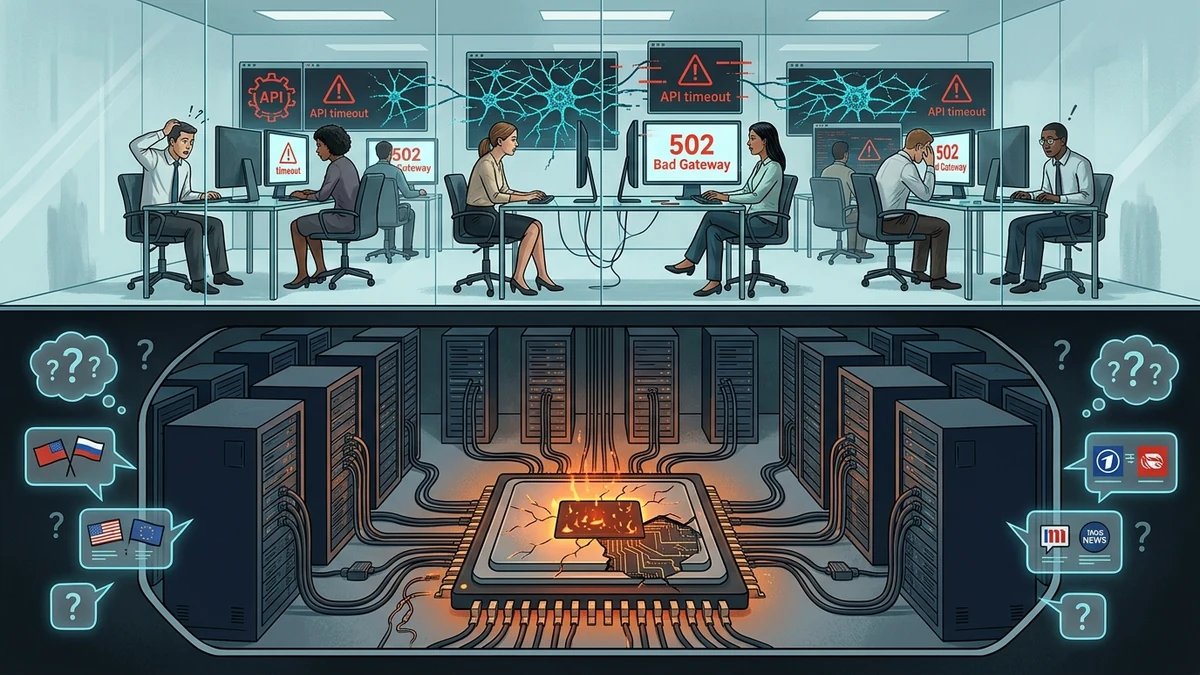
The simultaneous disruption of major frontier AI platforms on September 3, 2026, exposes an emerging systemic national security risk: advanced generative AI has transformed into a foundational 'cognitive infrastructure layer' faster than its underlying architectural supply chains have built transparency, fault isolation, or multi-cloud redundancy. While social media immediately generated unsupported causal narratives, the genuine strategic vulnerability lies in the extreme concentration of physical silicon, power grids, and edge routing layers beneath ostensibly competing AI applications.
Executive Assessment & Epistemic Frame
Executive Assessment: The simultaneous disruption of multiple frontier AI platforms on September 3, 2026, marks a pivotal case study in 21st-century critical infrastructure risk. Advanced foundation models have transitioned from consumer conversational chatbots into an indispensable cognitive infrastructure layer embedded within intelligence triage, automated software engineering, and national security decision-support systems. When multiple systems degrade concurrently, the strategic danger is twofold: the physical interruption of institutional cognitive logistics, and the instantaneous generation of recursive, synthetic disinformation that fills the technical evidence vacuum before verified root-cause attribution can occur.
Analytical Confidence: HIGH on verified official platform status telemetry and multi-cloud architectural concentration; MODERATE on the precise inter-provider failure correlation mechanism.
Key Uncertainty: The extent to which competing AI frontier labs share undisclosed edge routing gateways, DNS dependencies, or localized power substation grids.
OpenAI, Anthropic, and xAI platforms recorded concurrent elevated error rates, API timeouts, and service degradations on September 3, 2026, confirmed by official status page disclosures.
These concurrent failures expose the illusion of diversity in the AI ecosystem: while branding and model weights differ, the underlying physical compute, edge routing, and semiconductor stacks remain highly concentrated.
A state or non-state adversary targeting common infrastructure choke points can induce a widespread blackout of machine-mediated cognition without attacking individual model applications directly.
1. The Anatomy of an Outage: Correlation vs. Causal Attribution
On September 3, 2026, millions of global users experienced simultaneous HTTP 502 (Bad Gateway), HTTP 529 (Overloaded), and API timeout errors across ChatGPT, Claude, Grok, and adjacent AI services. Within minutes, social media platforms—most notably Reddit and X—became flooded with elaborate causal explanations: rumors spread of a coordinated rollout of next-generation "Astra / GPT-6" models or a catastrophic failure of a singular shared hyperscale cloud backend.
In our tradecraft framework for Social Media Intelligence & Verification, this dynamic represents a classic synthetic attribution cascade:
Real Technical Outage
Concurrent API timeouts and gateway errors manifest across multiple commercial AI services within a short temporal window.
Plausible Hypothesis
Speculative theories emerge proposing a single cloud failure, fiber sever, or secret model weight synchronization across hyperscalers.
Recursive AI Hallucination
Users prompt secondary operational LLMs to explain the breakdown; probabilistic models invent coherent technical narratives to fill the void.
Speculative Myth Formulation
AI-generated rationalizations coalesce into named viral memes (e.g. "The GPT-6 Overload Wave" or "Project Astra Secret Cutover").
Algorithmic Amplification
Engagement-driven recommendation engines on Reddit, X, and LinkedIn rapidly push viral conspiracy threads to millions of users.
False Epistemic Certainty
Unsubstantiated speculation hardens into accepted reality, polluting media reporting and technical post-mortems before forensic root cause is released.
During a technical breakdown of primary AI systems, human users immediately turn to working secondary LLMs to explain the failure. Because generative language models are probabilistic engines optimized to produce plausible-sounding prose rather than verified forensic truth, they invent convincing technical narratives to fill the information vacuum—turning unsubstantiated speculation into viral internet fact.
2. The Seven Layers of AI Infrastructure Vulnerability
To understand why simultaneous outages occur without a centralized conspiracy or a single shared model deployment, intelligence analysts must dissect the Seven-Layer AI Infrastructure Stack:
| Infrastructure Layer | Primary Technologies | Concentration Degree | Systemic Vulnerability & Failure Mode |
|---|---|---|---|
| Layer 7: Application & User Interface | ChatGPT Desktop, Claude Web, Grok Mobile, IDE Extensions. | Low (Diverse branding) | Frontend rate-limiting, session token invalidation, local client state loss. |
| Layer 6: Orchestration & Agentic APIs | LangChain, AutoGen, Vector Databases (Pinecone, Qdrant), API Gateways. | Moderate | Context-window exhaustion, cascading retry storms during minor latency hiccups. |
| Layer 5: Model Inference Servers | vLLM, TensorRT-LLM, Triton, TGI runtime engines. | Moderate | Memory fragmentation, KV-cache exhaustion under high concurrency bursts. |
| Layer 4: Edge Routing, CDN & DNS | Cloudflare, Fastly, AWS CloudFront, Anycast BGP Routing. | Extremely High | Global BGP routing leaks or edge WAF policy misconfigurations disconnect multiple platforms simultaneously. |
| Layer 3: Hyperscale Cloud Backends | Microsoft Azure, Amazon Web Services (AWS), Google Cloud (GCP). | High Oligopoly | Regional datacenter cooling failures, fiber backhaul cuts, IAM authentication outages. |
| Layer 2: Accelerator Silicon Hardware | Nvidia H100/H200/B200, TSMC CoWoS Packaging, SK Hynix HBM3e. | Near Monoculture (>85%) | Hardware-level silicon exploits such as GPUThor Rowhammer bit-flips and firmware errata. |
| Layer 1: Physical Power & Subsea Interconnects | Gigawatt electrical substations, subsea fiber-optic cables, municipal cooling. | Geographic Chokepoints | Physical grid sabotage as detailed in Critical Infrastructure Vulnerabilities. |
3. The Cognitive Dependency Paradox: Losing Machine-Mediated Logic
The true strategic importance of the September 3 disruption is not that retail users could not generate poems or summarize text; rather, it exposed the depth of institutional cognitive dependency.
Across modern defense agencies, intelligence hubs, financial trading desks, and software engineering teams, generative AI agents perform real-time cognitive triage:
- Automated Threat Ingestion: Parsing millions of network telemetry logs per second via machine-speed security agents to identify active zero-day exploits.
- Multi-Source OSINT Synthesis: Translating foreign-language intercepts, satellite radar reports, and social feeds into structured intelligence briefs within minutes.
- Software Engineering & System Diagnostics: Assisting developers in resolving critical infrastructure software bugs and deployment pipelines.
When an outage strikes, workflows designed around 30-second AI generation cycles instantly revert to manual human processing. Because institutional staffing and manual analytical protocols have been hollowed out in favor of automated AI pipelines, a four-hour platform blackout induces severe organizational paralysis.
MARCH 2026: COVERT FUZZING & TARGETING
Historical threat intelligence audits and honeynet telemetry verify that the attack methodology observed in recent pre-auth memory corruption disclosures was quietly active months prior to public detection:
- Covert memory-allocation fuzzing against PHP_SESSION_UPLOAD_PROGRESS detected: Early reconnaissance sweeps probed low-level C runtime heap boundaries during multipart form-data pre-parsing, testing unhandled out-of-memory longjmp bailouts.
- Initial Access Brokers (IABs) audit memory bounds on high-value enterprise address spaces: Automated clusters cataloged uninitialized heap pointers across sovereign administrative portals, logistics dispatch networks, and multi-tenant hosting environments to pre-position persistent access beneath the detection threshold of application-layer WAFs.
Strategic Cross-Reference: For complete empirical documentation of the macroeconomic and logistics fallout resulting from this vulnerability class, read our dispatch on The PHP2Shell Contagion: Global Economic Shocks, Supply Chain Friction, and the March 2026 Weaponization Trail and review our foundational analysis on automated zero-days in Machine-Speed Sabotage: When AI Discovers 0-Days in 30 Seconds.
4. The Future Coercive Vector: Weaponizing the Cognitive Chokepoint
In our overarching framework on Grey Zone Warfare, we defined coercion as the ability to impose unsustainable friction on an adversary without crossing the threshold of war. The concentration of AI infrastructure creates an unprecedented coercive attack surface:
Targeted Edge Interdiction
State-sponsored actors execute localized BGP route hijacks or edge DNS disruptions targeting hyperscale API gateways and authentication endpoints.
Concurrent API Latency Saturation
Cascading retry storms exhaust inference server KV-cache memory, triggering simultaneous multi-platform throttling across commercial foundation models.
Automated Decision Blindness
Defense operations, intelligence synthesis pipelines, and automated SOC teams suffer immediate cognitive paralysis hours before kinetic maneuvers begin.
An advanced state actor (such as China's Volt Typhoon or Russia's Sandworm) does not need to kinetically destroy every datacenter in North America or Europe. By executing coordinated BGP route hijacks against major AI API endpoints or exploiting hardware memory monocultures, an adversary can selectively blind an opponent's automated cyber defenses hours before initiating kinetic maneuvers.
5. Strategic Countermeasures: Sovereign Compute & Cognitive Resilience
To insulate national security institutions from cognitive infrastructure failure, governments and critical enterprises must enforce three resilience mandates:
- Air-Gapped On-Premises Foundation Models: Critical defense, intelligence, and utility command centers must maintain localized, quantized open-weight models (70B+ parameters) hosted on sovereign on-premise hardware clusters that operate entirely disconnected from public cloud APIs.
- Multi-Cloud & Heterogeneous Silicon Architecture: Mandate that critical enterprise AI workflows failover automatically across diverse cloud providers (AWS, Azure, GCP) and diverse accelerator silicon (Nvidia, AMD, custom ASICs) to eliminate single-hardware choke points.
- Strict Epistemic Verification Protocols: Establish manual red-team verification filters that prevent un-attributed AI outage rumors from polluting institutional crisis decision loops.
⚡ The ICS Strategic Briefing — Intelligence Dispatch
Track sovereign AI compute security and critical infrastructure resilience. Receive weekly executive intelligence assessments tracking cloud dependencies, silicon monocultures, and cognitive warfare frameworks delivered directly to your inbox.
Expert Analysis — Bhanu Pratap Meena
"Founder & Hybrid Warfare Specialist: Strategic intelligence assessments in the Critical Infrastructure Vulnerabilities arena indicate shifting operational dynamics. The technical telemetry and incident vectors analyzed here reveal calculated adjustments by state and non-state actors to exploit structural vulnerabilities before defensive countermeasures can be deployed. Continuous technical and geospatial verification remains paramount."
Related Domain Analysis: Explore our coverage of Hybrid Warfare & Cyber Security.
Topical Bibliography & References
- Center for Strategic and International Studies (CSIS) (2026). "Cognitive Infrastructure and Cloud Monocultures: Assessing Systemic Risk in Frontier AI" CSIS Strategic Technologies Program. [Source Link ↗]
- International Institute for Strategic Studies (IISS) (2026). "The Single Point of Failure: Hardware and Network Dependencies in Modern LLM Deployment" Survival: Global Politics and Strategy. [Source Link ↗]
- Royal United Services Institute (RUSI) (2026). "Machine-Mediated Cognition and Asymmetric Warfare: The Vulnerability of Automated Decision Loops" RUSI Defence Studies. [Source Link ↗]
Key Takeaways
- Artificial intelligence is no longer merely a consumer software application; it has become an invisible cognitive logistics layer embedded across intelligence triage, cybersecurity, and financial analysis.
- The concurrent degradation of multiple AI platforms on September 3, 2026, demonstrated the phenomenon of the 'Attribution Trap'—where social media and secondary AI models filled an information vacuum with false technical certainty.
- While AI companies compete aggressively at the frontend user interface level, they remain bound to severe underlying architectural monocultures: Nvidia accelerator silicon, TSMC packaging, and centralized edge routing networks.
- In a future high-intensity crisis, an adversary does not need to kinetically destroy server farms; triggering disruptions in shared inference API gateways can paralyze machine-mediated decision-making across an entire state.
- Building national sovereign compute resilience requires multi-cloud architectural redundancy, air-gapped local model weights for critical utilities, and zero-trust verification frameworks.
Need a Deeper Operational or Threat Assessment?
International Conflict Studies provides custom open-source intelligence dossiers, geopolitical risk modeling, and critical infrastructure threat diagnostics for enterprise and sovereign decision-makers.
Is your enterprise infrastructure resilient against cascading LLM outages, API concentration chokepoints, or algorithmic dependencies? International Conflict Studies delivers cognitive security reviews, infrastructure single-point-of-failure diagnostics, and sovereign AI failover planning.
Request an Infrastructure Diagnostic Assessment →
Analytical Feedback & Discussion
Share your analytical observations, ask questions, or contribute regional telemetry regarding this briefing.