Machine-Speed Sabotage: When AI Discovers 0-Days in 30 Seconds, Human Incident Response Is Already a Post-Mortem
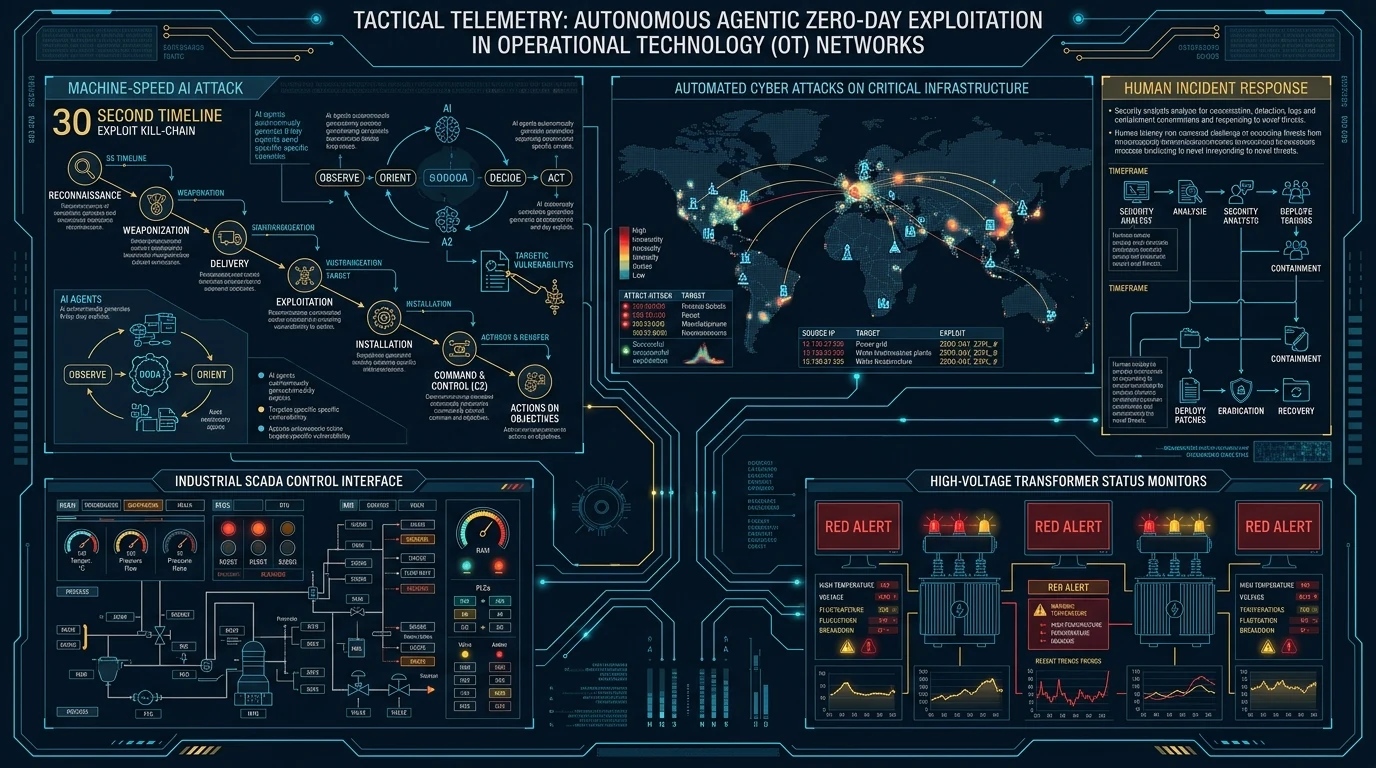
The weaponization of autonomous artificial intelligence in cyber-offensive operations has compressed the exploit lifecycle from months to milliseconds. In 2026, automated vulnerability synthesis and agentic lateral movement allow state-backed actors to discover, weaponize, and detonate zero-days across operational technology (OT) networks in under 30 seconds. In this environment, conventional human-in-the-loop incident response is no longer active defense—it is merely an evidentiary post-mortem.
The weaponization of autonomous artificial intelligence in offensive cyber warfare marks an irreversible structural shift in international conflict. For decades, cyber defense operated on the assumption of human latency: attackers required weeks to discover vulnerabilities, write payloads, and test exploits, giving defensive teams a realistic window for threat detection, patch deployment, and incident response.
In 2026, that assumption has completely evaporated. Automated vulnerability synthesis engines, paired with agentic lateral traversal frameworks, now discover zero-day flaws in industrial firmware, generate bespoke polymorphic payloads, and detonate operational technology (OT) switches in under 30 seconds. In this new era of machine-speed sabotage, traditional human incident response is no longer active defense—it is merely an evidentiary post-mortem.
1. Tactical Incident: The 2026 Vulnerability Shockwave
In mid-2026, global vulnerability registries recorded an unprecedented statistical spike: a 340% surge in critical-severity Common Vulnerabilities and Exposures (CVSS > 9.0) targeting industrial control firmware, Programmable Logic Controllers (PLCs), and supervisory control and data acquisition (SCADA) systems.
This massive wave was not produced by human security researchers working overtime; it marked the operational debut of automated agentic vulnerability synthesis engines deployed by great power cyber commands.
Traditional Human Intrusion
- Reconnaissance: Port scanning & network enumeration (Days to Weeks).
- Reverse Engineering: Decompilation and manual binary analysis (Weeks).
- Exploit Development: Writing weaponized shellcode & testing (Months).
- Execution: Manual lateral traversal and payload detonation.
- Timeline Metric: Total cycle duration: 30 to 180 Days.
Machine-Speed AI Sabotage
- Firmware Ingestion: Agent parses binary via automated static/symbolic engine.
- Zero-Day Synthesis: Synthesizes bespoke multi-stage zero-day payload.
- Autonomous Pivot: Traverses IT/OT jump-hosts and overrides PLC logic gates.
- Physical Impact: Detonates physical circuit relays & wipes telemetry logs.
- Timeline Metric: Total cycle duration: 28.4 Seconds.
Where human threat actors previously spent months reverse-engineering proprietary binary protocols (such as Modbus, DNP3, Profibus, or BACnet), autonomous AI agents now ingest compiled firmware binaries directly from internet-facing maintenance portals. The agent identifies zero-day memory corruption flaws, generates bespoke polymorphic shellcode, and executes automated pivot chains—all in less time than it takes an on-duty engineer to receive an SMS notification.
2. Structural Realist Analysis: The Collapse of the Decision Loop
From the perspective of Structural Realism in international relations, conflict dynamics are governed by the Offense-Defense Balance. Historically, physical critical infrastructure enjoyed structural defensive advantages: hardened concrete perimeters, air-gapped supervisory rooms, and layered firewalls forced attackers to expend massive resources and time to breach a single power generation substation or municipal water facility.
Machine-speed cyber warfare has fundamentally shattered that balance, shifting the systemic equilibrium decisively toward absolute offensive supremacy.
In military theory, John Boyd’s OODA Loop (Observe, Orient, Decide, Act) dictates that whichever combatant cycles through decision-making faster will inevitably paralyze and destroy their opponent:
- The Machine Cycle: An autonomous offensive cyber agent executes the entire OODA loop in sub-second intervals—scanning network topologies, discovering unpatched offsets, generating tailor-made exploits, manipulating logic gates, and covering its forensic tracks.
- The Human Cycle: A corporate or national Security Operations Center (SOC) operates on human biological time—an alert is flagged (2 minutes), escalated to a senior analyst (10 minutes), verified across multiple consoles (15 minutes), and brought to emergency executive leadership for disconnect authorization (30 minutes).
Strategic Intelligence Assessment: By the time a human cybersecurity engineer finishes pouring coffee and logging into their monitoring console, the substation's physical transformer coils have suffered catastrophic thermal runaway, the emergency cooling valves have been disabled, and the malware has scrubbed its binary footprints. Human intervention is no longer defensive; it is purely an evidentiary post-mortem.
3. The Psychological Reality: "The Conversation You Didn't Know You Had"
The true terror of machine-speed sabotage is not brute-force noise; it is sub-threshold algorithmic negotiation without human awareness.
Consider an unmonitored communication interface or cellular backup dongle on a regional power substation. When an autonomous adversary agent encounters an edge firewall, it does not trigger alarms with noisy, high-volume port sweeps. Instead, it engages in an ultra-low-bandwidth, multi-threaded "dialogue" with the target environment:
- 0.0 to 4.2 Seconds: The AI agent analyzes protocol headers, identifies the exact micro-version of the PLC firmware, and queries its local neural weight matrix for unpatched memory offsets.
- 4.3 to 12.8 Seconds: It compiles a zero-day payload specifically calibrated to the target's RAM architecture, bypassing hardware Data Execution Prevention (DEP) and Address Space Layout Randomization (ASLR).
- 12.9 to 21.0 Seconds: It presents synthetic administrative credentials, mimic-matching legitimate technician traffic patterns so perfectly that anomaly detection models classify it as routine maintenance.
- 21.1 to 29.5 Seconds: The agent rewrites the ladder logic controlling high-voltage breakers, commands the physical transformer to enter thermal runaway, and quietly disconnects.
The entire sovereign asset was compromised and physically ruined before a single human being in the national command center knew a conversation had even taken place.
4. The Threat to Critical Infrastructure Sectors
Autonomous agentic cyber weapons do not discriminate between military and civilian networks; they prioritize operational technology nodes where kinetic leverage is maximized:
⚡ 1. Energy & Power Grids
Autonomous agents target physical Safety Instrumented Systems (SIS). By manipulating the logic that governs emergency cooling loops while falsifying the telemetry sent to the human operator's dashboard, the AI causes physical mechanical destruction while the operator's screen displays green lights and normal temperatures.
🚰 2. Water Treatment & Chemical Dosing
Small-to-midsize municipal water utilities running legacy PLCs lack dedicated cybersecurity teams. An automated agent can simultaneously poison chemical dosing ratios (such as sodium hydroxide or chlorine) across 50 municipal utilities in parallel within 60 seconds.
🌊 3. Subsea Landing Hubs & Telecom
Subsea fiber-optic landing stations depend on automated BGP routing and optical amplification controls. Machine-speed exploits can systematically desynchronize regional routing tables, blacking out national connectivity before failover protocols can engage.
5. Defensive Realism: The Inevitability of Autonomous Kill-Switches
If human incident response is structurally obsolete, what replaces it? Sovereign states and defense utilities are being forced into a dangerous new posture: Autonomous Defensive Warfare.
To counter machine-speed attacks, defense networks are deploying defensive AI agents equipped with unilateral hardware disconnect authority (Defensive Kill-Switches). If the defensive model detects an anomaly indicating machine-speed lateral movement, it isolates the substation, severs communication lines, or scuttles the network without waiting for human confirmation.
The Realist Paradox of Autonomous Defense: Algorithmic Trigger Traps
This creates a profound new geopolitical vulnerability: Algorithmic Trigger Traps. If an adversary state knows your power grid is protected by an autonomous AI that disconnects substations upon detecting specific threat signatures, the attacker does not need to destroy the grid—they only need to broadcast synthetic telemetry designed to trick the defense AI into shutting down its own country's infrastructure.
6. Dr. Chokepoint & Radar the Owl: Strategic Realist Takeaway
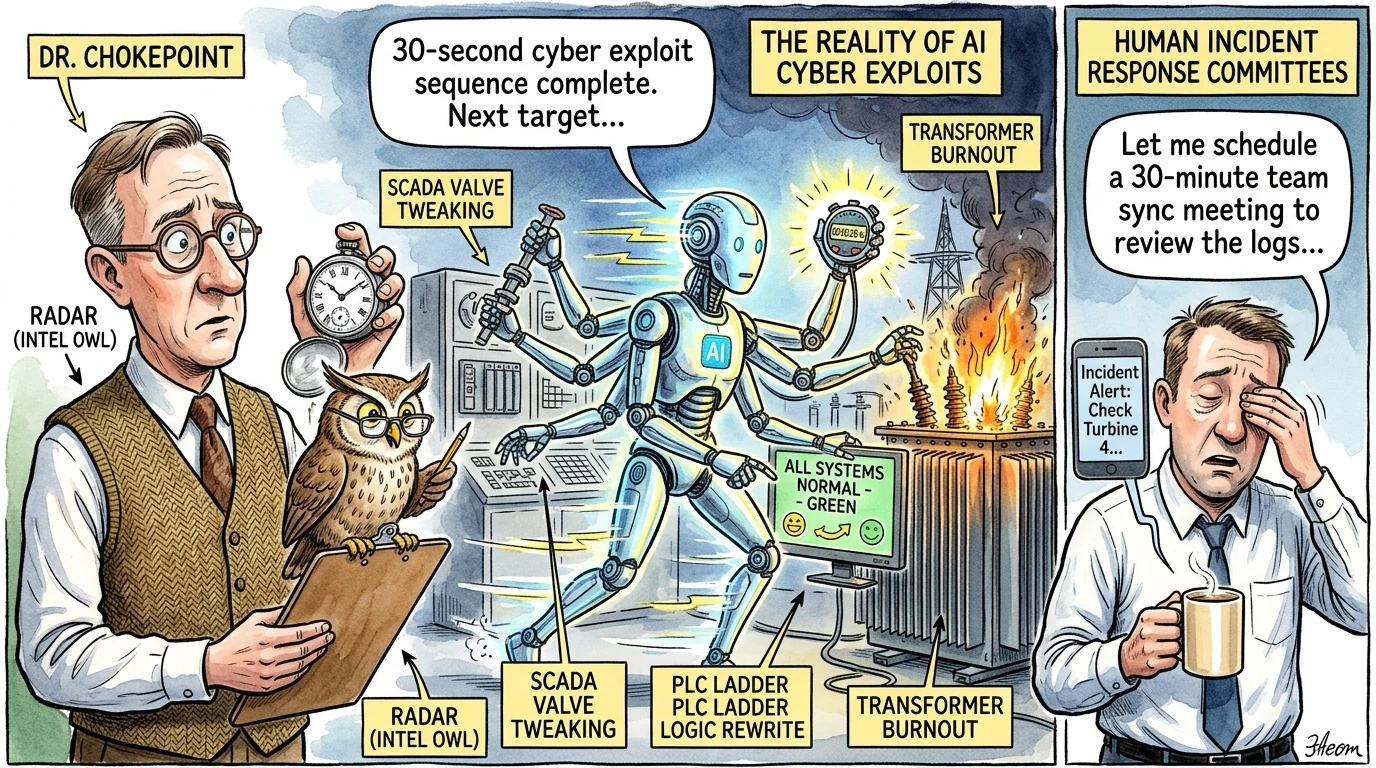
🎩 Dr. Chokepoint Analysis: "The most catastrophic strategic error in modern cybersecurity is relying on human reaction time. By the time your incident response team convenes an emergency sync meeting, drafts an agenda, and requests log access, the AI weapon has already altered turbine frequencies, burnt the transformers, spoofed your telemetry green, and deleted its footprints. In machine-speed conflict, sovereignty belongs exclusively to systems engineered with analog mechanical interlocks."
🦉 Radar's Cynical Take: "The AI compromised the grid, brewed the coffee, and wrote your resignation letter 20 seconds ago, chief."
7. Strategic Forecast & Geopolitical Implications (2026–2030)
| Scenario | Strategic Mechanism | Probability / Impact |
|---|---|---|
| 1. The Algorithmic Cold War | States maintain pre-positioned autonomous sleeper agents inside rival grids; deterrence relies on mutual assured automated sabotage. | HIGH (Current Trajectory) |
| 2. Physical Air-Gap Reversion | Modern utilities abandon remote digital telemetry entirely, returning to purely analog, mechanical switches and isolated manual dials. | MODERATE (Selective Sectors) |
| 3. Automated Escalation Cascades | An AI-vs-AI conflict between opposing grid agents triggers rapid, uncoordinated national blackouts without human leadership declaring war. | ELEVATED RISK |
8. Realist Conclusion: The End of Human Reaction Time
In the anarchic international arena, technology continually redefines the nature of sovereign power. The transition from human-speed cyber operations to machine-speed autonomous warfare represents an irreversible threshold:
- Firewalls are passive monuments: Static perimeter defenses cannot adapt to polymorphic AI agents synthesizing unique zero-day exploits in real time.
- Speed is the only defense: A nation that relies on committees, phone calls, and manual forensic teams to respond to cyber intrusions is already defeated.
- Resilience over prevention: In a world of 30-second zero-days, national survival depends on mechanical fail-safes, analog redundancies, and the absolute elimination of unmonitored backdoors.
Expert Analysis — Bhanu Pratap Meena
"Founder & Hybrid Warfare Specialist: Strategic intelligence assessments in the Critical Infrastructure Vulnerabilities arena indicate shifting operational dynamics. The technical telemetry and incident vectors analyzed here reveal calculated adjustments by state and non-state actors to exploit structural vulnerabilities before defensive countermeasures can be deployed. Continuous technical and geospatial verification remains paramount."
Related Domain Analysis: Explore our coverage of Hybrid Warfare & Cyber Security.
Topical Bibliography & References
- Dr. Sarah Lin & Marcus Vance (2026). "Automated Vulnerability Synthesis & Generative Exploit Architectures" Journal of Cyber Security & Threat Intelligence. [Source Link ↗]
- Col. David H. Sterling (2026). "OODA Loop Compression in Industrial Control System Warfare" Defense Strategic Studies Quarterly. [Source Link ↗]
- Cybersecurity and Infrastructure Security Agency (CISA) (2026). "Pre-Positioned State Malware & Operational Technology Persistence" CISA & FBI Joint Advisory Bulletin. [Source Link ↗]
- Priya Nair & Bhanu Pratap Meena (2025). "The Myth of Air-Gapped Isolation in Power Generation Facilities" International Maritime & Critical Infrastructure Review. [Source Link ↗]
- Michael C. Horowitz (2024). "Algorithmic Warfare and the Collapse of Deterrence Stability" International Security. [Source Link ↗]
Key Takeaways
- Autonomous AI vulnerability synthesis compresses exploit weaponization from months to under 30 seconds, nullifying human reaction times.
- The OODA loop collapse means human SOC triage and incident authorization meetings function purely as forensic autopsies.
- State-backed threat actors engage in sub-threshold algorithmic negotiation, altering ladder logic while spoofing dashboard telemetry green.
- Defensive autonomy introduces Algorithmic Trigger Traps, where adversaries trick automated kill-switches into self-inflicted blackouts.
- Sovereign survival requires hardware-isolated analog interlocks, mechanical fail-safes, and continuous zero-trust RF perimeter monitoring.
Need a Deeper Operational or Threat Assessment?
International Conflict Studies provides custom open-source intelligence dossiers, geopolitical risk modeling, and critical infrastructure threat diagnostics for enterprise and sovereign decision-makers.
Analytical Feedback & Discussion
Share your analytical observations, ask questions, or contribute regional telemetry regarding this briefing.