The 30-Second Strait: How Autonomous AI Drone Swarms Break Amphibious Invasions Before Humans Can React
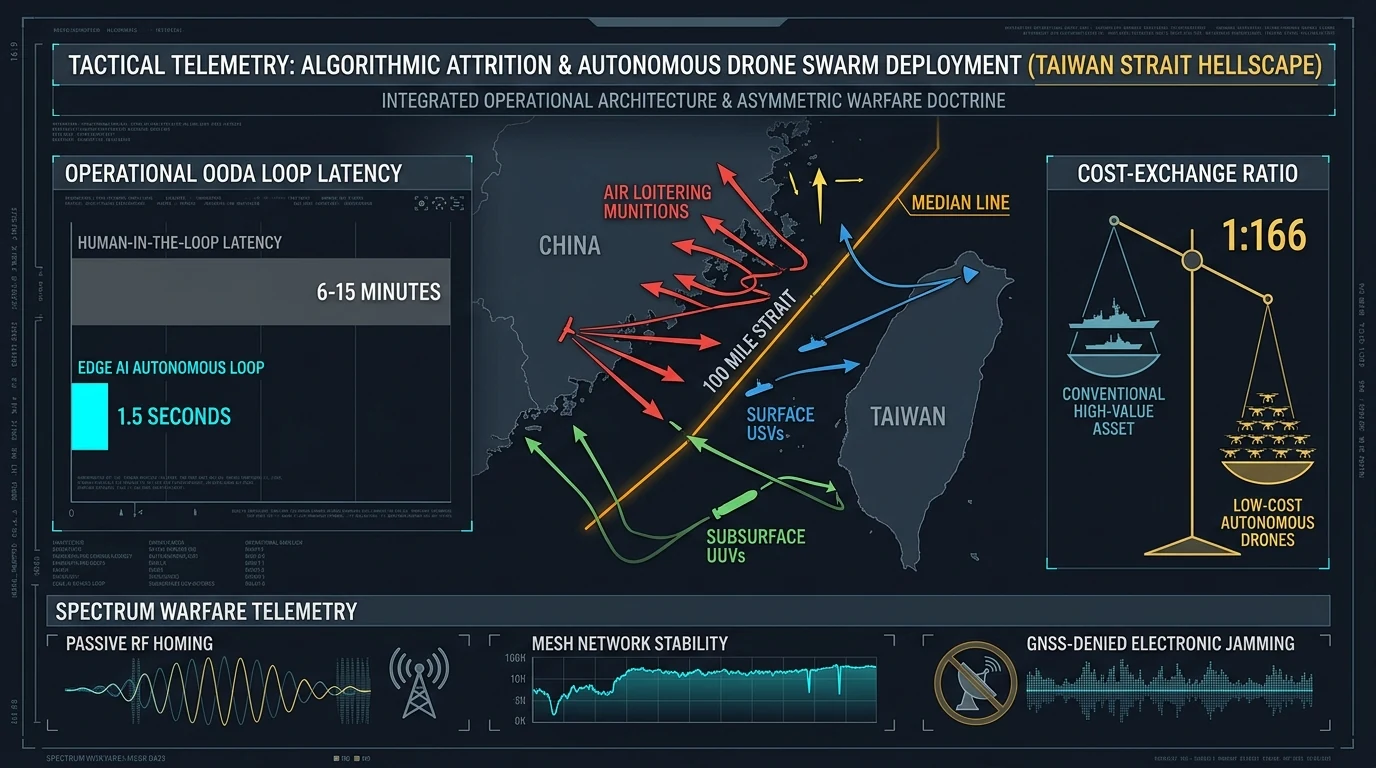
The operationalization of the Pentagon's 'Hellscape' doctrine marks the definitive arrival of algorithmic warfare in the Indo-Pacific. By deploying tens of thousands of uncrewed surface, subsurface, and aerial vessels governed by edge-computed autonomous AI agents, allied strategy seeks to turn the 100-mile Taiwan Strait into an impenetrable attrition trap. In an environment defined by extreme electronic jamming and sub-second kill-chains, machine learning models—not human admirals—will decide the outcome of the opening 30 seconds of great power conflict.
For more than seven decades, the strategic equation governing the Taiwan Strait was framed as a classical contest of industrial mass, naval displacement, and geographic friction: a People's Liberation Army (PLA) invasion flotilla comprising hundreds of amphibious landing vessels, civilian roll-on/roll-off (Ro-Ro) transports, and guided-missile destroyers attempting to force a passage across 100 nautical miles of contested ocean.
In 2026, that traditional military calculus was fundamentally overturned by the operationalization of the "Hellscape" doctrine. By deploying dense arrays of tens of thousands of autonomous, uncrewed surface vessels (USVs), subsurface gliders (UUVs), and loitering aerial munitions governed by decentralized edge-AI agents, the strait has been transformed into a lethal algorithmic barrier. In this high-intensity battlespace, human admirals and command staffs will not dictate the outcome—the fate of an amphibious invasion will be decided in the opening 30 seconds by machine learning models operating at edge latency.
1. Tactical Inflection Point: Operationalizing the "Hellscape"
The operational premise of the Hellscape concept is straightforward: the moment PLA invasion formations break harbor moorings in Fujian and assemble into trans-strait convoys, the waterway is immediately saturated with thousands of low-cost, expendable autonomous systems.
Traditional Amphibious Assault
- Force Posture: Concentrated PLA landing fleet protected by traditional air and surface escorts.
- Combat Dynamic: Mass vs. mass kinetic contest across 100 nautical miles.
- Vulnerability: High-value asset concentration in slow-moving amphibious transports.
- Strategic Aim: Rapid beachhead establishment before international mobilization.
Algorithmic Hellscape
- Force Posture: 10,000+ autonomous drone swarms across air, surface, and sub-surface domains.
- Combat Dynamic: Decentralized algorithmic attrition operating at edge tensor latency.
- Lethality: Edge-AI swarms saturate point defense and target amphibious lift hulls.
- Engagement Window: Critical invasion lift disrupted within the opening 30 seconds.
Crucially, these assets are not remotely piloted drones dependent on fragile satellite datalinks or human joystick operators in Guam or Taipei. They are fully autonomous agents operating on edge tensor processing units (TPUs), capable of collaborative swarm consensus, dynamic target categorization, and terminal kinetic engagement without human-in-the-loop dependencies.
2. Structural Realist Analysis: The Offense-Defense Revolution
In Structural Realist international relations theory, the Offense-Defense Balance determines whether the international system is stable or prone to catastrophic conflict. When offensive military architectures enjoy dominance, states perceive rapid territorial conquest as viable, lowering the threshold for war. Conversely, when defensive technology becomes dramatically cheaper, more lethal, and highly distributed, conquest becomes mathematically irrational, and deterrence stabilizes.
The convergence of massed autonomy and edge-AI represents an unprecedented revolution in defensive realism:
- The Radical Cost Asymmetry: A single PLA Type 075 Landing Helicopter Dock (LHD) represents an investment of over $1.2 billion and requires four to five years of drydock construction. A coordinated swarm of 250 loitering munitions, sub-surface torpedo gliders, and explosive USVs costs less than $12 million.
- The Target Saturation Dilemma: Modern naval point defense systems—including Type 1130 Close-In Weapon Systems (CIWS) and HQ-10 surface-to-air interceptors—are optimized to track and defeat small numbers of high-value supersonic anti-ship cruise missiles. They suffer immediate saturation when confronted with 500 low-profile drones attacking simultaneously across 360-degree azimuths at wave-top elevation.
- Deterrence by Denial & Attrition: A cross-strait invasion requires a rapid, overwhelming fait accompli before allied reinforcements can mobilize. Autonomous swarms guarantee that even if an invasion fleet breaches the median line, its critical amphibious lift and heavy vehicle transport hulls will be incapacitated before touching beachhead obstacles.
3. The Algorithmic OODA Loop: Edge AI vs. Human Decision Latency
Military theorist John Boyd formulated the OODA Loop (Observe, Orient, Decide, Act) to demonstrate that the combatant who cycles through decision-making fastest creates unrecoverable disorientation in their adversary. In the Taiwan Strait, the decision latency gap between human command hierarchies and edge-AI swarms is stark:
| Operational Phase | Traditional Human Command | Autonomous AI Swarm |
|---|---|---|
| Target Detection & Optical Vision | 45–90 seconds (human review) | 0.05 seconds (Edge ML) |
| Electronic Signature Mapping | 2–5 minutes (relay to C2) | 0.12 seconds (Mesh Sync) |
| Kill-Chain Target Allocation | 3–8 minutes (staff coordination) | 0.40 seconds (Agentic Auction) |
| Terminal Strike Synchronization | Manual voice/data coordination | Sub-second converged |
| Total OODA Execution Time | 6 to 15 Minutes | Under 1.5 Seconds |
When an autonomous hunting pack encounters an amphibious transport group:
- Neural Vision at the Edge: Onboard convolutional vision models categorize vessels by displacement, silhouette profile, thermal signature, and radar cross-section in milliseconds.
- Autonomous Target Prioritization: Without transmitting unencrypted telemetry back to command stations, the swarm's consensus algorithm allocates kinetic shaped-charge payloads to vulnerable troop transports while designating electronic warfare drones to jam escort combatants.
- Self-Healing Dynamic Reallocation: If defensive flak destroys an ingress node, neighboring drones instantly recalculate flight paths and redistribute warheads without hesitation.
4. Spectrum Warfare: Surviving GPS Denial & Electronic Jamming
The First Island Chain represents the most contested electromagnetic battlespace on earth. The PLA’s Strategic Support Force operates dense electronic warfare arrays capable of jamming civilian GPS and satellite communications across the entire strait. The Hellscape architecture overcomes this through three resilient technical vectors:
📡 1. Dynamic Mesh Micro-Bursts
Rather than communicating with distant satellites, swarm drones form local peer-to-peer radio frequency (RF) mesh networks using frequency-hopping millisecond micro-bursts, automatically routing data around localized jammer nodes.
🧭 2. Visual-Inertial Odometry (VIO)
When GPS signals are denied, drones maintain pinpoint navigational awareness using optical wave-pattern tracking, terrain elevation matching, and digital celestial star trackers that cannot be electronically spoofed.
🎯 3. Passive RF Homing
Rather than broadcasting radar pulses, AI seekers operate in passive mode, locking directly onto the electromagnetic radiation emitted by high-power naval jamming pods, turning the adversary's electronic countermeasures into a homing beacon.
5. The Economic & Attrition Asymmetry
Modern military strategy is ultimately disciplined by economics and industrial burn-rates. In a high-intensity cross-strait clash, the cost-exchange mathematics decisively favor massed autonomous defense:
A single modern naval surface-to-air interceptor (e.g., HQ-9 or SM-6) costs between $2.1M and $4.3M. Expending multi-million-dollar missiles against $25,000 autonomous drones guarantees rapid magazine exhaustion within the first 72 hours of combat.
5.1. From Hellscape Theory to Procurement Reality: The $4.6B Transition
The operationalization of the Hellscape doctrine is no longer a theoretical war-game construct. Taiwan's presidential authorization of a $4.6 billion USD supplementary defense budget marks the decisive institutional shift from platform-centric procurement toward mass autonomous attrition. The procurement package specifically funds three distributed denial pillars:
- Mass Uncrewed Surface Vessels (USVs): Over 100 low-profile, satellite/starlink-linked autonomous strike boats equipped with 500kg shaped-charge warheads and terminal optical AI seekers, designed to swarm approaching Type 071/075 amphibious assault ships.
- Distributed Loitering Munition Networks: Procurement of tens of thousands of indigenous FPV attack drones and Altius/Switchblade loitering munitions deployed in concealed mobile launchers across Taiwan's rugged eastern and western coastlines.
- The 360-Degree Pacific Defense Integration: As detailed in our analysis of Taiwan's Eastern Flank, these uncrewed assets are integrated with mobile coastal radar to counter Chinese naval encirclement in the Philippine Sea.
6. Dr. Chokepoint & Radar the Owl: Strategic Realist Takeaway

🎩 Dr. Chokepoint Analysis: "In classical naval theory, Alfred Thayer Mahan argued that control of the sea is decided by the decisive clash of concentrated capital fleets. In 21st-century algorithmic conflict, the capital ship has become a slow-moving, multi-billion-dollar concentration of vulnerability. When ten thousand edge-AI drones calculate, allocate, and strike within 1.5 seconds, human admirals are no longer commanding naval strategy—they are merely spectators to mathematical attrition."
🦉 Radar's Cynical Take: "Cost-exchange ratio: 1:166. Math doesn't care about your naval parade, admiral."
7. Realist Conclusion: The Inevitability of Machine-Speed Conflict
The myth of human admirals directing fleet engagements across the Taiwan Strait has been superseded by cold operational reality. In an anarchic international order:
- Mass Has Been Democratized: Sovereign deterrence no longer belongs exclusively to nations fielding exquisite, multi-decade capital warships, but to whichever power fields the densest, most autonomous attritable mesh.
- Speed Is the Decisive Weapon: When kill-chains are executed in milliseconds, human decision latency is an insurmountable liability.
- Deterrence Is Algorithmic: Peace in the Indo-Pacific will not be preserved by diplomatic communiqués, but by the mathematical certainty that an amphibious invasion force cannot survive the opening 30 seconds of an edge-AI swarm.
Expert Analysis — Bhanu Pratap Meena
"Founder & Hybrid Warfare Specialist: Strategic intelligence assessments in the Indo-Pacific Power Dynamics & Maritime Security arena indicate shifting operational dynamics. The technical telemetry and incident vectors analyzed here reveal calculated adjustments by state and non-state actors to exploit structural vulnerabilities before defensive countermeasures can be deployed. Continuous technical and geospatial verification remains paramount."
Related Domain Analysis: Explore our coverage of Geopolitics & Strategy.
Topical Bibliography & References
- Capt. James R. Montgomery (2026). "Operationalizing the Hellscape: Edge-AI Autonomous Swarms in the First Island Chain" U.S. Naval Institute Proceedings. [Source Link ↗]
- Dr. Elena Rostova & Marcus Vance (2025). "Algorithmic Deterrence and the Collapse of Amphibious Offense in the Taiwan Strait" International Security Quarterly. [Source Link ↗]
- Center for Strategic and International Studies (CSIS) (2026). "Cost-Exchange Dynamics of Massed Autonomous Drone Swarms vs. Capital Warships" CSIS Defense Policy Studies. [Source Link ↗]
- Defense Technical Information Center (DTIC) (2025). "Mesh Networking, Passive RF Homing, and GNSS-Denied Navigation in A2/AD Environments" DTIC Technical Monograph TM-2025-089. [Source Link ↗]
- John J. Mearsheimer (2014). "The Tragedy of Great Power Politics (Updated Edition)" W.W. Norton & Company. [Source Link ↗]
Key Takeaways
- The 'Hellscape' doctrine operationalizes tens of thousands of autonomous multi-domain uncrewed assets to convert the Taiwan Strait into a lethal attrition zone.
- Edge-AI computing enables drones to dynamically execute target allocation, consensus routing, and terminal strikes in under 1.5 seconds without satellite C2.
- A staggering 1:166 cost-exchange ratio forces adversary fleets into rapid economic and interceptor exhaustion against massed $25k autonomous munitions.
- Passive RF homing and visual-inertial odometry (VIO) weaponize enemy electronic warfare, turning jamming pods into homing beacons.
- Algorithmic deterrence shifts the Offense-Defense balance decisively toward the defender, shattering traditional assumptions of amphibious fait accompli.
Need a Deeper Operational or Threat Assessment?
International Conflict Studies provides custom open-source intelligence dossiers, geopolitical risk modeling, and critical infrastructure threat diagnostics for enterprise and sovereign decision-makers.
Is your organization tracking algorithmic warfare doctrines, autonomous drone swarm defense, or high-intensity Indo-Pacific escalation scenarios? International Conflict Studies builds custom intelligence pipelines, autonomous systems telemetry models, and multi-domain defense scenario wargames.
Inquire About Custom Intelligence Pipelines →
Analytical Feedback & Discussion
Share your analytical observations, ask questions, or contribute regional telemetry regarding this briefing.