The Circulation War: How Precision Infrastructure Strikes Target National Export Financing
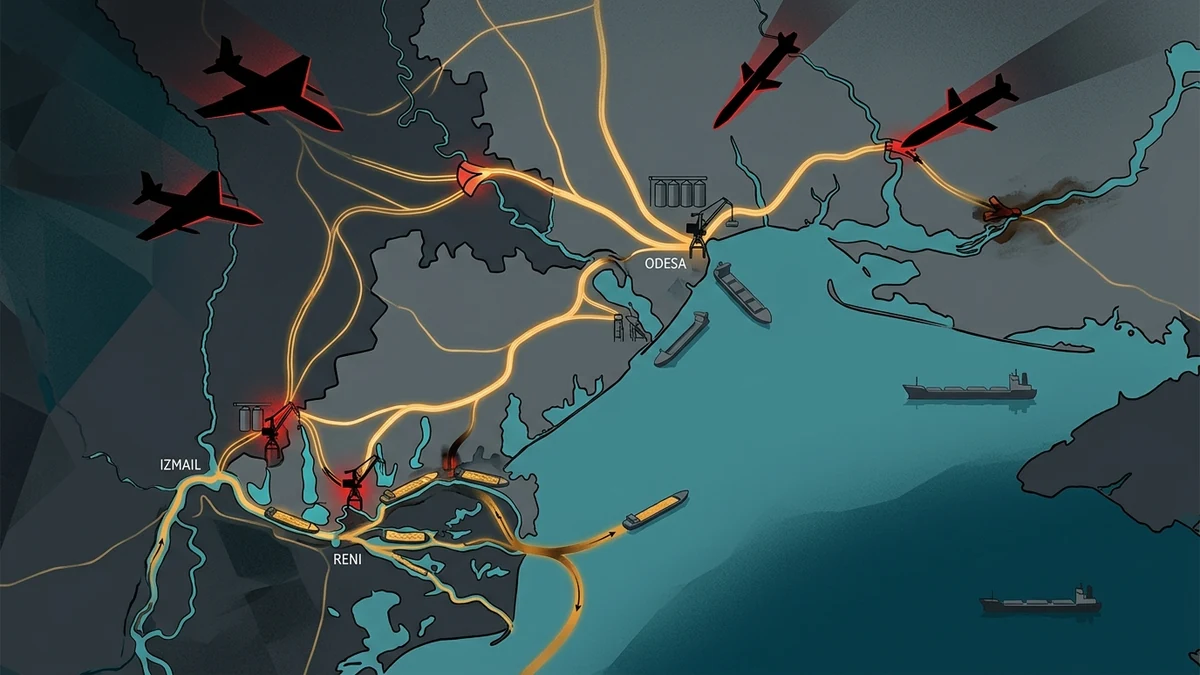
Circulation Warfare describes the systematic military targeting of the physical nodes, transport arteries, and transshipment bottlenecks that connect a defending nation's domestic production to global revenue markets. In Ukraine, the Russian Federation has transitioned from broad counter-value urban bombardment toward precision economic interdiction—systematically striking Odesa port berths, Danube river barge terminals (Izmail, Reni), Romanian border crossings (Orlivka), and electrical traction substations to induce sovereign bankruptcy.
Executive Assessment & Epistemic Frame
Executive Assessment: Russian military strategy in Ukraine has consolidated into an aggressive doctrine of Circulation Warfare. Rather than expending high-end munitions solely on fortified frontline positions or broad terror bombardment, Russian strike packages systematically target the narrow transport arteries, transshipment elevators, and border crossings that generate sovereign export cash flow. By degrading grain loading facilities in Greater Odesa, striking Danube barge terminals in Izmail and Reni, and destroying electrical rail traction substations, Moscow aims to sever Ukraine's financial lifeblood and exhaust Western budget subsidies.
Analytical Confidence: HIGH | Commercial satellite imagery, Ukrainian Ministry of Infrastructure damage reports, and Black Sea grain export tracking confirm concentrated kinetic targeting of logistical transshipment choke points.
Key Uncertainty: The speed at which European rail operators and Romanian port authorities in Constanța can absorb additional overland cargo volume during prolonged electrical grid blackouts in southern Ukraine.
Russian strike waves repeatedly target grain elevators, container cranes, and electrical railway junctions across Odesa, Chornomorsk, Izmail, and the Orlivka-Isaccea border crossing with Romania.
This is not random collateral damage; it is an optimized economic counter-value campaign aimed at severing the logistical nodes that convert domestic harvest and steel production into foreign currency.
Without viable export circulation, defending states become 100% dependent on foreign direct financial aid, making national sovereignty vulnerable to shifting political elections in allied capitals.
1. The Concept of Circulation Warfare: Severing the Economic Arteries
In classical military theory, victory was achieved either by destroying the enemy's army in the field (Clausewitz) or capturing the capital city. In our foundational analysis of Critical Infrastructure Vulnerabilities, we established that modern industrial states are integrated biological systems: their combat resilience is strictly dictated by the continuous, high-volume circulation of commodities, energy, and revenue.
Circulation warfare does not require occupying farmland or bombing every tractor. If an adversary can destroy the railway switchgear that transports grain to port, the gantry cranes that load the ships, or the customs checkpoints at border rivers, the commodity remains physically trapped inside the country. Grain rots in silos, export contracts are canceled, tax revenues collapse, and the sovereign treasury faces insolvency.
2. The Three Logistical Bottlenecks of Ukrainian Export Circulation
| Export Corridor Node | Primary Target Infrastructure | Throughput Capacity | Strategic Vulnerability & Impact |
|---|---|---|---|
| 1. Greater Odesa Ports (Odesa, Pivdennyi, Chornomorsk) | Deep-water grain loading berths, container gantries, port electrical substations. | 65% of total agricultural exports. | Vulnerable to Iskander-M ballistic missiles and Shahed drone strikes within 120-second flight windows. |
| 2. The Danube River Ports (Izmail, Reni, Kiliya) | River grain elevators, barge loading cranes, fuel transshipment pipelines. | 25% of agricultural and fuel transit. | Shallow draft operations; directly adjacent to Romanian NATO border, creating political escalation risks. |
| 3. Western Rail Corridors & Gauge Break Hubs | Electrical railway substations, broad-to-standard gauge bogie-exchange facilities (Mostyska, Chop). | 10% of container and mineral trade. | Grid blackouts halt electric locomotives, forcing reliance on limited diesel fleets and creating massive border rail queues. |
3. The Strategic Mechanism: The Cost-Exchange of Port Destruction
Circulation warfare weaponizes the massive asymmetry between the cost of destruction and the cost of repair:
- The Offensive Cost: A Russian Shahed-136 loitering drone costs approximately $20,000 to $40,000. Firing a salvo of ten drones costs less than $400,000.
- The Economic Destruction: A single successful drone strike that ignites a grain elevator destroys $15 million to $30 million in agricultural machinery and grain stocks, while rendering the berth inoperable for 6 to 9 months.
- The Secondary Lawfare Consequence: As explored in The Insurance Trigger, strikes on civilian port infrastructure cause international maritime underwriters to double or triple war-risk insurance premiums, pricing commercial bulk cargo ships out of the Black Sea humanitarian corridor.
4. Strategic Countermeasures: Hardening the Circulatory System
To survive sustained circulation warfare, defending nations and allied logistics partners must implement four structural countermeasures:
- Point-Defense Air Shielding of Transshipment Nodes: Deploying short-range mobile counter-UAS teams (Gepard, Skynex, high-power microwave systems) directly over port cranes and railway substations.
- Decentralized Grain Storage & Mobile Conveyors: Shifting away from massive monolithic grain silos toward distributed modular grain bag storage and mobile pneumatic ship-loaders that can be repositioned within hours.
- Diesel Locomotive Strategic Reserves: Transitioning critical border freight operations from vulnerable electrical traction power to autonomous diesel and dual-fuel locomotives.
- Sovereign State-Backed Maritime Reinsurance: Guaranteeing shipowners full compensation through bilateral state indemnity pools, as deployed in our analysis of The Shadow Blockade.
⚡ The ICS Strategic Briefing — Intelligence Dispatch
Track critical infrastructure warfare and sovereign logistics interdiction. Receive weekly executive intelligence assessments tracking port strikes, rail bottlenecks, and Black Sea maritime security delivered directly to your inbox.
Expert Analysis — Shubham Saroj
"OSINT Analyst & Intelligence Researcher: Strategic intelligence assessments in the Regional Conflict Evaluations arena indicate shifting operational dynamics. The technical telemetry and incident vectors analyzed here reveal calculated adjustments by state and non-state actors to exploit structural vulnerabilities before defensive countermeasures can be deployed. Continuous technical and geospatial verification remains paramount."
Related Domain Analysis: Explore our coverage of Geopolitics & Strategy.
Topical Bibliography & References
- Center for Strategic and International Studies (CSIS) (2026). "Economic Circulation and Modern Siege Warfare: The Interdiction of Export Corridors" CSIS Europe, Russia, and Eurasia Program. [Source Link ↗]
- International Institute for Strategic Studies (IISS) (2026). "The Danube Lifeline: Logistics Bottlenecks and Russian Precision Strikes in Odesa Oblast" Survival: Global Politics and Strategy. [Source Link ↗]
- Royal United Services Institute (RUSI) (2026). "Asymmetric Economic Targeting: Infrastructure Attrition in Protracted Industrial Wars" RUSI Military Sciences. [Source Link ↗]
Key Takeaways
- Circulation warfare operates on the premise that an agrarian or industrial economy cannot sustain wartime mobilization if its export goods cannot physically reach international buyers.
- Russian strikes targeting Danube river terminals (Izmail, Reni) and the Orlivka ferry crossing attack the primary redundancy corridor that bypassed the Black Sea naval blockade.
- Targeting electrical traction substations and railway grain transshipment elevators converts Ukraine's rail network from an agile logistics lifeline into a static bottleneck.
- Defending export circulation requires mobile counter-UAS air defense umbrellas, localized harbor electronic warfare jamming, and rapid modular bridge-repair units.
- Circulation warfare validates the modern conflict rule: victory is achieved not by occupying territory, but by making sovereign resistance economically unfinanceable.
Need a Deeper Operational or Threat Assessment?
International Conflict Studies provides custom open-source intelligence dossiers, geopolitical risk modeling, and critical infrastructure threat diagnostics for enterprise and sovereign decision-makers.
Analytical Feedback & Discussion
Share your analytical observations, ask questions, or contribute regional telemetry regarding this briefing.