The Shadow Blockade: Maritime Insurance, Floating Logistics and the Economics of Chokepoint War
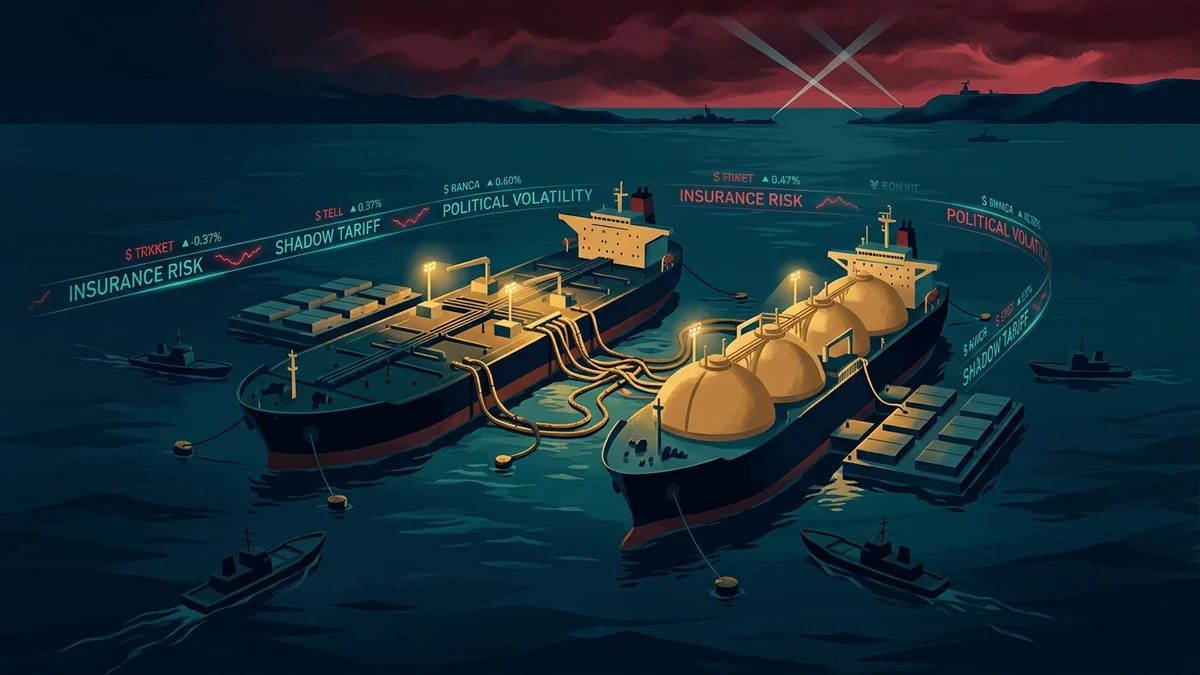
The Shadow Blockade describes the emerging structural reality of maritime conflict: when a strategic chokepoint becomes permanently contested, global energy commerce does not halt—it mutates. In response to US-Iran hostilities in the Strait of Hormuz, energy exporters from Qatar and the UAE have initiated floating ship-to-ship (STS) LNG transfers and deep-sea crude lightering in the Sea of Oman, constructing an ad-hoc offshore logistics architecture that absorbs massive permanent economic friction to bypass war-risk insurance exclusion zones.
Executive Assessment & Epistemic Frame
Executive Assessment: The escalating maritime confrontation in the Persian Gulf has triggered the emergence of a Shadow Blockade. Rather than waiting for naval coalitions to secure the Strait of Hormuz, commercial LNG and crude operators across Qatar, the UAE, and international energy trading houses are redesigning global energy supply chains. By establishing deep-water ship-to-ship (STS) cargo transfer hubs, utilizing offshore floating storage units (FSUs), and deploying non-Western insurance pools outside the Gulf of Oman, global markets are adapting to permanent chokepoint unreliability at the cost of structural, systemic logistics inflation.
Analytical Confidence: HIGH | Commercial AIS vessel tracking, satellite optical surveillance of Fujairah/Khor Fakkan anchorages, and ship-broker charter agreements confirm regularized STS transfer operations.
Key Uncertainty: The environmental safety thresholds and port-state regulatory tolerance for high-volume offshore cryogenic LNG transfers during monsoon weather conditions.
Commercial energy traders have regularized ship-to-ship LNG and crude transfers in the Sea of Oman, loading feeder tankers inside the Gulf and transferring cargoes to long-haul carriers outside the Strait of Hormuz.
This represents the privatization of chokepoint risk. Instead of relying on state naval escorts, commercial operators bypass war-risk insurance zones through structural logistics workarounds.
A permanent shadow logistics network creates long-term energy price inflation and establishes parallel non-Western shipping standards that resist international sanctions.
1. The Shift from Military Escort to Commercial Adaptation
In classical defense analysis of maritime chokepoints, the standard response to hostile interdiction was the deployment of allied naval convoys (such as Operation Earnest Will in 1987 or Operation Sentinel in 2019). However, in our strategic assessment of The Chokepoint War in Hormuz, we demonstrated why legacy naval escorts fail against modern asymmetric loitering drones and acoustic naval mines.
Modern commercial energy shipping operates on razor-thin voyage margins and rigid institutional underwriting. When a $200 million Q-Flex LNG carrier enters an active war-risk zone, its hull insurance can spike by millions of dollars per day. Commercial charterers have realized that it is cheaper to charter two vessels and conduct offshore cargo transfers outside the threat envelope than to sail a single premier vessel through a contested strait.
2. The Three Pillars of the Shadow Blockade Architecture
| Operational Component | Tactical Execution | Economic Cost Profile | Strategic Trade-Off |
|---|---|---|---|
| 1. Shuttle-to-Ocean Feeder Relay | Older, low-value shuttle tankers load at Ras Laffan / Das Island, sail through Hormuz, and pump cargo to premier VLCCs in the Gulf of Oman. | +$1.80 to +$2.50 per barrel transfer surcharge. | Protects Tier-1 capital fleets while accepting calculated risk on disposable feeder hulls. |
| 2. Offshore Floating Storage Units (FSUs) | Anchoring Ultra Large Crude Carriers (ULCCs) permanently 50 NM off the coast of Fujairah as floating hydrocarbon buffer depots. | High capital lockup ($40k–$60k/day charter rates). | Decouples extraction schedules from immediate maritime export chokepoint transit windows. |
| 3. Sovereign Reinsurance Pools | State-backed insurance guarantees (China, India) replacing London P&I clubs to bypass war-risk surcharges. | Direct sovereign balance sheet liability. | Erodes Western financial lawfare leverage as analyzed in The Insurance Trigger. |
3. Cryogenic Risk: The Technical Limits of Offshore LNG Transfers
While crude oil lightering has been practiced for decades, conducting ship-to-ship transfers of Liquefied Natural Gas (LNG) at -162°C (-260°F) in open-ocean swells represents an extraordinary technical challenge:
- Cryogenic Boil-Off Gas (BOG): Every hour an LNG carrier remains moored in open ocean heat results in thermal boil-off, reducing the delivered energy payload.
- Dynamic Mooring Stress: Unlike sheltered ports, oceanic swell forces can rupture emergency quick-disconnect couplings (PERCs), risking catastrophic cryogenic spills and hull embrittlement.
- Specialized FSRU Chokepoints: Only a limited number of specialized offshore transfer vessels with subsea cryogenic hoses currently exist globally, capping the maximum volume that can bypass Hormuz via this method to under 15% of total Gulf LNG production.
4. The Strategic Paradox: The Permanent Friction Tax
The creation of a Shadow Blockade solves the immediate crisis of total supply disruption, but it institutionalizes a permanent structural friction tax across global supply chains:
Multi-Hose STS Relay Delays
Complex deep-sea ship-to-ship transfers in open ocean swells require specialized fenders and weather windows, slowing transfer throughput by over 60%.
+4 to +7 Days Turnaround Latency
Supertankers and LNG carriers face prolonged queuing times outside the Persian Gulf, drastically reducing effective global fleet tonnage capacity.
Higher Base Energy Cost
Downstream utilities and industrial grids in Japan, South Korea, and the EU absorb higher CIF landed costs, converting grey-zone friction into inflation.
By forcing global shipping into complex offshore workarounds, the adversary achieves its core grey-zone objective: draining the economic surplus of its opponents without sustaining the massive military retaliation that would follow a declared physical blockade.
5. Strategic Indicators to Watch (2026–2027)
To monitor the institutionalization of the Shadow Blockade, intelligence analysts should track three operational indicators:
- Fujairah Anchorage Density: Satellite Synthetic Aperture Radar (SAR) metrics tracking the number of anchored VLCCs and LNG carriers outside the Persian Gulf.
- Sovereign Reinsurance Legislation: Formal legislative authorizations in Tokyo, Seoul, and New Delhi providing state-backed indemnity for non-London insured vessels.
- STS Berth Licensing in the Sea of Oman: Bilateral maritime agreements between Oman, UAE, and major Asian energy utilities establishing permanent offshore lightering zones.
⚡ The ICS Strategic Briefing — Intelligence Dispatch
Track commercial maritime chokepoints and shadow energy logistics. Receive weekly executive intelligence assessments tracking ship-to-ship transfers, war-risk insurance indices, and global chokepoint telemetry delivered directly to your inbox.
Expert Analysis — Pratyush Deo Tiwary
"Senior Analyst, Conflict Studies & Geopolitics: Strategic intelligence assessments in the Regional Conflict Evaluations arena indicate shifting operational dynamics. The technical telemetry and incident vectors analyzed here reveal calculated adjustments by state and non-state actors to exploit structural vulnerabilities before defensive countermeasures can be deployed. Continuous technical and geospatial verification remains paramount."
Related Domain Analysis: Explore our coverage of Geopolitics & Strategy.
Topical Bibliography & References
- Center for Strategic and International Studies (CSIS) (2026). "Floating Logistics and Chokepoint Evasion: Commercial Adaptation in the Persian Gulf" CSIS Energy Security and Geopolitics Program. [Source Link ↗]
- International Institute for Strategic Studies (IISS) (2026). "The Economics of Ship-to-Ship Transfers and Maritime Insurance Arbitrage" Survival: Global Politics and Strategy. [Source Link ↗]
- Royal United Services Institute (RUSI) (2026). "Subsea Mines, Missile Baselines, and the Limits of Naval Escort Operations" RUSI International Maritime Studies. [Source Link ↗]
Key Takeaways
- Commercial maritime logistics adapts to persistent military risk by creating decentralized offshore transfer hubs rather than relying on military naval escorts.
- Ship-to-ship (STS) LNG transfers in international waters outside the Strait of Hormuz allow exporters to isolate expensive Western-flagged carriers from high-risk combat zones.
- The transition to a Shadow Blockade imposes a structural 'friction tax' on global energy consumers: longer voyage times, multiple vessel charter fees, and offshore transfer shrinkage.
- Traditional naval convoy doctrines (Operation Sentinel / Earnest Will models) are structurally insufficient for modern commercial fleets operating under strict private insurance covenants.
- The emerging maritime architecture creates a two-tier shipping system: high-risk compliant Western carriers vs. un-sanctioned dark fleet tankers operating under sovereign state guarantees.
Need a Deeper Operational or Threat Assessment?
International Conflict Studies provides custom open-source intelligence dossiers, geopolitical risk modeling, and critical infrastructure threat diagnostics for enterprise and sovereign decision-makers.
Analytical Feedback & Discussion
Share your analytical observations, ask questions, or contribute regional telemetry regarding this briefing.