The Armed Shipping Lane: Coalition Escorts and the Militarization of Commercial Navigation
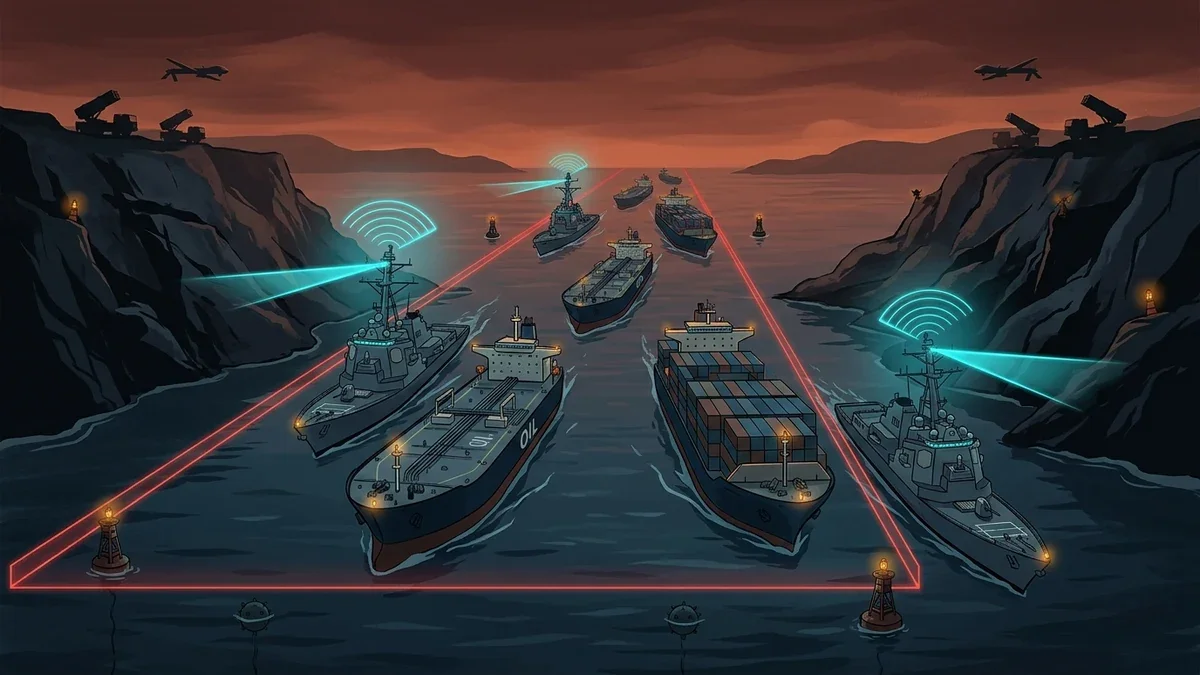
When commercial shipping requires continuous military naval escorts to transit a sovereign chokepoint, the waterway has ceased to function as a civilian commercial lane. As South Korea reviews naval deployments alongside US and regional forces in the Strait of Hormuz, the global energy architecture is transitioning from an insurance-based market mechanism into an armed, coalition-dependent convoy system. While oil tankers continue moving, freedom of navigation has effectively become a permanent, low-intensity military campaign.
Executive Assessment & Epistemic Frame
Executive Assessment: South Korea's formal review of military naval deployments to protect commercial tankers transiting the Persian Gulf signals a decisive structural shift in Middle Eastern maritime security. The international community is abandoning reliance on purely commercial market mechanisms—such as private armed security guards and inflated war-risk insurance underwriting—in favor of a permanent multinational naval escort regime. While this armed posture prevents immediate closure of the waterway, it codifies a dangerous reality: the world's most critical energy artery is now an active military theater where civilian commerce operates solely under the protective radar umbrella of foreign warships.
Analytical Confidence: HIGH on ROK Ministry of National Defense operational deliberations and regional naval deployment tracking; MODERATE on the final bilateral rules of engagement (ROE) established between Asian coalition partners and US Central Command.
Key Uncertainty: Whether Iran's Islamic Revolutionary Guard Corps Navy (IRGCN) will deliberately target non-Western escorted vessels to test coalition cohesion.
South Korea's government officially confirmed it is reviewing military measures—including expanding the operational mandate of its Cheonghae Anti-Piracy Unit—to escort national commercial tankers through the Strait of Hormuz.
This transition marks the failure of commercial market insulation. When private underwriters cancel war-risk coverage, sovereign defense fleets must physically subsidize maritime transport.
Escort operations introduce rigid convoy scheduling that reduces daily global oil flow velocity by 25%–40%, institutionalizing an armed risk premium in global energy prices.
1. The Illusion of an Open Chokepoint: Freedom of Navigation as a Campaign
In classical maritime law under the UN Convention on the Law of the Sea (UNCLOS), commercial vessels enjoy unhindered transit passage through international straits. In our initial assessment of The Chokepoint War in Hormuz, we demonstrated how sub-threshold drone harassment and naval mine ambiguity shatter this peacetime legal assumption.
When a civilian supertanker carrying 2 million barrels of crude oil cannot sail unless flanked by an Aegis guided-missile destroyer, the chokepoint is no longer a commercial transit corridor—it is an armed shipping lane. The strategic paradox is acute: while political leaders claim the strait remains 'open', the operational friction, military manpower commitment, and tactical rules of engagement mirror those of an active wartime amphibious theater.
2. Why East Asia Cannot Stand Aside: The Asymmetric Dependency Ratio
While the United States maintains the primary naval presence in the Persian Gulf (US 5th Fleet / NAVCENT), the physical hydrocarbons transiting Hormuz do not sail to North America. Over 82% of all crude oil and LNG transiting Hormuz heads directly to Asian ports:
| Nation State | Share of Crude Imports via Hormuz | Current Strategic Response | Vulnerability Profile |
|---|---|---|---|
| South Korea (ROK) | ~70% to 72% | Deploying KDX-II Destroyers (Cheonghae Unit) into Hormuz escort tracks. | Zero domestic fossil reserves; industrial petrochemical base halts within 60 days of total closure. |
| Japan | ~85% to 88% | Maritime Self-Defense Force (JMSDF) information-gathering patrol aircraft (P-3C/P-1) in Gulf of Oman. | Constitutional limits on collective self-defense restrict direct kinetic convoy escorts inside Iranian waters. |
| China | ~45% to 50% | Direct diplomatic guarantees with Tehran + PLA Navy base in Djibouti. | Relies on sovereign reinsurance and geopolitical alignment to secure unhindered transit. |
| India | ~55% to 60% | Operation Sankalp (Indian Navy stealth frigates patrolling Gulf of Oman & Arabian Sea). | Strategic energy buffer dependent on Russian crude imports and Great Nicobar maritime chokepoints. |
3. The Convoy Friction Problem: The Economics of Militarized Logistics
While escort operations mitigate the immediate physical risk of ship seizures, they introduce massive systemic inefficiencies into global energy delivery:
The Escort Convoy Friction Cascade
Staging & Marshalling
VLCC supertankers wait 3–5 days outside Fujairah / Gulf of Oman anchorages to assemble into escort groups.
Reduced Convoy Speed
Formation transit speeds capped at 10–12 knots to maintain warship defensive screening geometry.
Global Throughput Drop
Simultaneous convoy arrivals trigger destination terminal congestion, offloading queues, and charter rate spikes.
- Marshalling Delays: Under normal peacetime conditions, a supertanker transits Hormuz immediately upon loading at Ras Tanura or Das Island. Under an escort regime, vessels must anchor in designated staging areas for 3 to 5 days while a multi-ship convoy is assembled.
- Formation Speed Constraints: A convoy must travel at the speed of its slowest member—typically 10 to 12 knots—extending the transit window through the high-threat Iranian missile envelope from 4 hours to over 9 hours.
- Port Congestion & Terminal Spikes: Convoys arriving simultaneously at Asian destination refineries overwhelm offloading jetties, creating multi-week demurrage queues that inflate freight charter rates globally.
4. The Munitions Asymmetry Dilemma: High-End Warships vs. Low-Cost Threats
Deploying multinational naval destroyers to escort merchant ships creates an unsustainable tactical cost-exchange ratio:
- The Offensive Arsenal: The IRGCN utilizes massed fast-attack craft (FAC), loitering attack drones ($20k–$40k), and bottom-moored acoustic influence mines ($10k).
- The Defensive Burden: An Aegis destroyer or South Korean KDX-II must defend a 300-meter-long unarmored crude carrier by expending $2.1M SM-2 or $4.3M SM-6 interceptors against incoming salvos.
- Magazine Exhaustion: Even advanced destroyers carry only 32 to 96 vertical launch system (VLS) cells. In a prolonged saturation skirmish, escorting warships must exhaust their interceptor magazines within 72 hours, forcing them to withdraw to distant ports (such as Bahrain or Oman) for multi-day re-arming operations.
5. Strategic Outlook: The Three Future Trajectories of Hormuz Escorts
- Institutionalization of a Permanent Escort Coalition (Base Case): South Korea, Japan, the US, and European partners formalize a standing multinational convoy task force, accepting permanent economic friction (+15% energy transport surcharges) as the baseline cost of Middle Eastern stability.
- The Shift to the Shadow Blockade: Escort delays and insurance premiums become so burdensome that commercial operators increasingly abandon formal convoys in favor of ship-to-ship offshore transfers outside Hormuz.
- Escalatory Kinetic Rupture: A successful asymmetric strike against an escorted tanker triggers direct allied retaliation against Iranian shore-based missile sites on Qeshm or Larak Island, converting the escort campaign into an open regional war.
Expert Analysis — Pratyush Deo Tiwary
"Senior Analyst, Conflict Studies & Geopolitics: Strategic intelligence assessments in the Regional Conflict Evaluations arena indicate shifting operational dynamics. The technical telemetry and incident vectors analyzed here reveal calculated adjustments by state and non-state actors to exploit structural vulnerabilities before defensive countermeasures can be deployed. Continuous technical and geospatial verification remains paramount."
Related Domain Analysis: Explore our coverage of Geopolitics & Strategy.
Topical Bibliography & References
- Center for Strategic and International Studies (CSIS) (2026). "Militarizing the Chokepoints: Coalition Naval Escorts from Earnest Will to Operation Sentinel" CSIS International Security Program. [Source Link ↗]
- International Institute for Strategic Studies (IISS) (2026). "East Asian Energy Security and the Strait of Hormuz: South Korea's Maritime Dilemma" Survival: Global Politics and Strategy. [Source Link ↗]
- Royal United Services Institute (RUSI) (2026). "Convoy Economics: The Structural Limits of Modern Naval Escort Warfare" RUSI International Maritime Studies. [Source Link ↗]
Key Takeaways
- Multinational naval escorts in the Strait of Hormuz represent the militarization of civilian commerce: merchant ships can no longer navigate based on market incentives alone.
- South Korea's consideration of naval deployments reflects the extreme vulnerability of East Asian energy importers (Seoul imports ~70% of its crude oil through Hormuz).
- Naval convoys create acute operational bottlenecks: grouping tankers into escorted flotillas reduces daily transit throughput by 25% to 40% compared to free-flowing commercial traffic.
- The defender's cost asymmetry remains unsustainable: deploying $1.8B Aegis destroyers and expending $2M+ SM-2 interceptors to defend against $20,000 loitering drones leads to rapid magazine exhaustion.
- Escorts do not solve the underlying political conflict; they institutionalize an armed standoff that normalizes Iranian coercion as a permanent feature of global energy pricing.
Need a Deeper Operational or Threat Assessment?
International Conflict Studies provides custom open-source intelligence dossiers, geopolitical risk modeling, and critical infrastructure threat diagnostics for enterprise and sovereign decision-makers.
Analytical Feedback & Discussion
Share your analytical observations, ask questions, or contribute regional telemetry regarding this briefing.