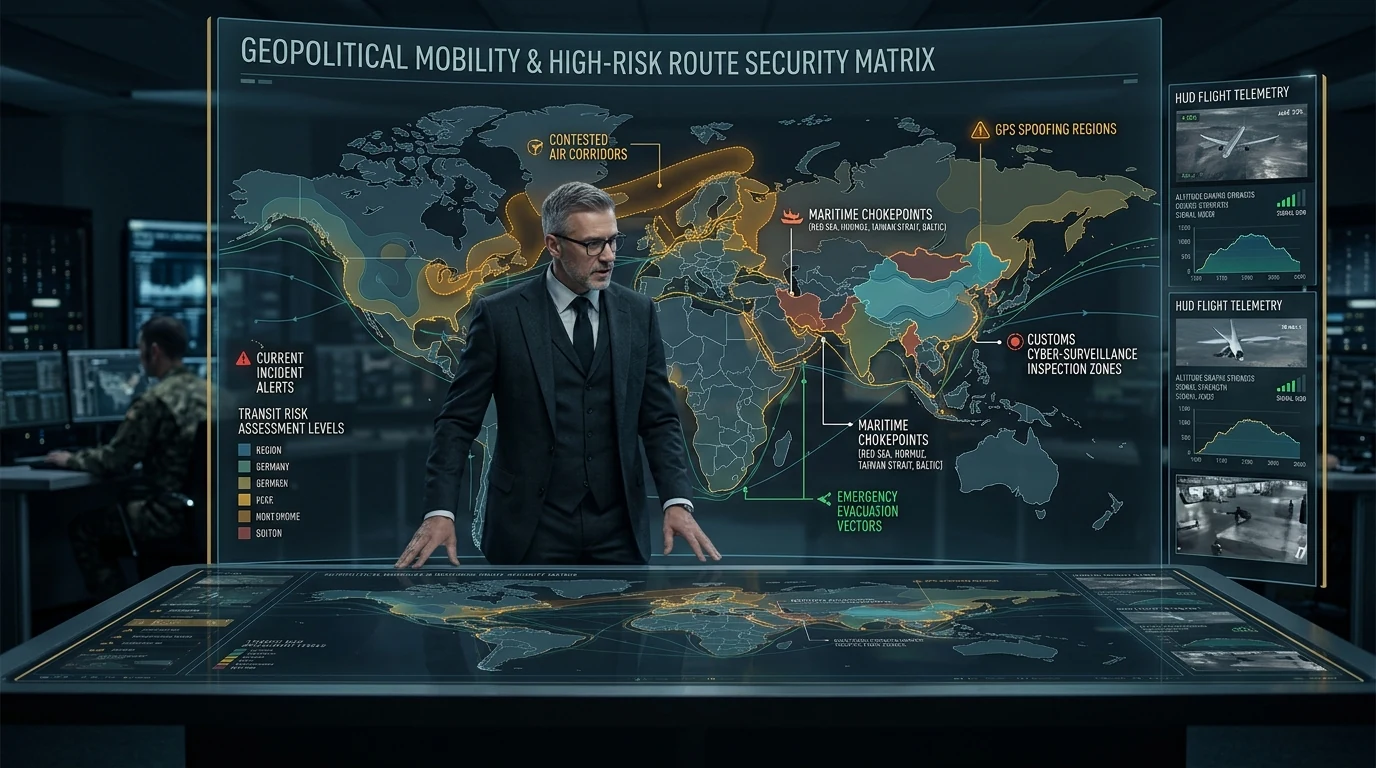
In an era of multi-domain hybrid warfare and sudden territorial escalations, budget travel routing and standard business travel agencies represent critical operational vulnerabilities. When corporate executives, NGO directors, or research teams cut logistical corners across volatile corridors, they expose themselves to active electronic warfare (GNSS spoofing), sudden airspace closures, grey-zone border device extractions, and logistical paralysis. Cheap travel is an econometric calculation; route security is a sovereign survival requirement.
The contemporary geopolitical landscape is defined by the rapid breakdown of peacetime assumptions. Across the Middle East, Eastern Europe, the South China Sea, and the transboundary Himalayan frontier, commercial transit corridors increasingly intersect with active grey-zone operations.
For organizations operating internationally, corporate travel procurement is typically managed as a procurement optimization exercise: minimize ticket expenditure, consolidate hotel tiers, and rely on standard post-incident travel insurance. Yet as recent conflicts have repeatedly demonstrated, cheap travel is not a defence against geopolitical disruption.
1. The Airspace Illusion: Electronic Warfare & Missile Corridors
Commercial airlines operating on ultra-efficient, budget-optimized flight paths frequently route through narrow civil air corridors adjacent to active conflict zones. Over the Baltic Sea, the Eastern Mediterranean, and the Black Sea, commercial airliners routinely experience high-intensity GNSS jamming and false-signal spoofing, forcing pilots to revert to inertial navigation systems and creating acute collision hazards.
When sudden kinetic skirmishes erupt—such as ballistic missile salvos or drone swarm interceptions—civil aviation authorities issue emergency NOTAMs (Notices to Airmen) within minutes. Budget carriers lacking dedicated geopolitical risk desks often leave passengers stranded at intermediate hubs, incurring immense downstream losses in executive time, corporate security, and emergency rerouting expenses.
2. Border Customs as an Intelligence Weapon: The Device Extraction Trap
Crossing international borders in politically sensitive jurisdictions is no longer a routine bureaucratic check. State intelligence services increasingly utilize border immigration checkpoints as forward digital collection nodes:
- Forced Forensic Data Extractions: Customs officials in authoritarian and revisionist states routinely demand passwords or physically mirror corporate laptops and mobile devices using forensic software (such as Cellebrite UFED).
- Telecom & IMSI-Catcher Interceptions: Connecting to local cellular networks immediately exposes unhardened devices to state-level IMSI catchers, logging IMSI/IMEI identifiers and intercepting unencrypted metadata.
- Lawfare & Hostage Diplomacy: Corporate personnel traveling under ambiguous commercial or tourist visas can be instantly leveraged as bargaining chips under broad 'national security' or 'espionage' statutes.
3. The Dr. Chokepoint Realist Takeaway
🎩 Dr. Chokepoint Analysis: "Enterprise procurement officers congratulate themselves on shaving $400 off a flight itinerary, oblivious to the fact that their executive's laptop was just cloned at a frontier customs checkpoint and their secondary route passes directly beneath an unannounced cruise missile testing sector. True operational security is not bought at checkout; it is engineered through pre-deployment threat modeling and continuous telemetry."
🦉 Radar's Cynical Take: "Budget flights in conflict zones: save 15% on booking, spend $50,000 on an emergency overland evacuation."
4. The 5-Pillar Geopolitical Mobility Protocol
To institutionalize genuine duty of care, organizations must transition from reactive travel booking to proactive mobility intelligence:
- Pre-Deployment Threat Profiling: Conduct multi-sensor OSINT audits of destination political stability, regulatory changes, and local civil unrest indicators prior to ticket issuance.
- Digital Perimeter Sanitization: Implement clean burner devices, hardware security keys, and hardened offline operating systems for personnel crossing contested frontiers.
- Corridor Electronic Warfare Verification: Review real-time ADS-B telemetry and GPS interference maps to avoid high-density jamming airspace.
- Secondary & Overland Evacuation Mapping: Pre-establish multi-modal overland routes and localized emergency contact nodes before boots touch the ground.
- Retained Crisis Telemetry: Subscribe to continuous chokepoint flash dispatches that trigger immediate alerts upon early-stage border closures or supply chain paralysis.
Expert Analysis — Bhanu Pratap Meena
"Founder & Hybrid Warfare Specialist: In modern conflict, mobility is a tactical vulnerability. Whether analyzing subsea cables or executive transit, the principle remains constant: single-point dependencies and unmonitored chokepoints guarantee operational failure. Organizations must treat executive mobility as an intelligence discipline, not an administrative errand."
Deploying Personnel to Contested or High-Risk Jurisdictions?
International Conflict Studies delivers pre-deployment threat modeling, electronic warfare corridor audits, and 24/7 chokepoint emergency monitoring for sovereign and enterprise clients.
Key Takeaways
- Cheap travel procurement creates single-point operational vulnerabilities in volatile geopolitical regions.
- Contested civil airspace is frequently subject to GPS jamming, signal spoofing, and unexpected emergency NOTAM closures.
- Border crossings in authoritarian states function as forensic intelligence nodes for device data extraction.
- Genuine organizational duty of care requires pre-deployment OSINT threat modeling and burner OPSEC protocols.