How Hidden Nuclear Programs Are Discovered: Intelligence, IAEA Verification and the Deir el-Zour Case
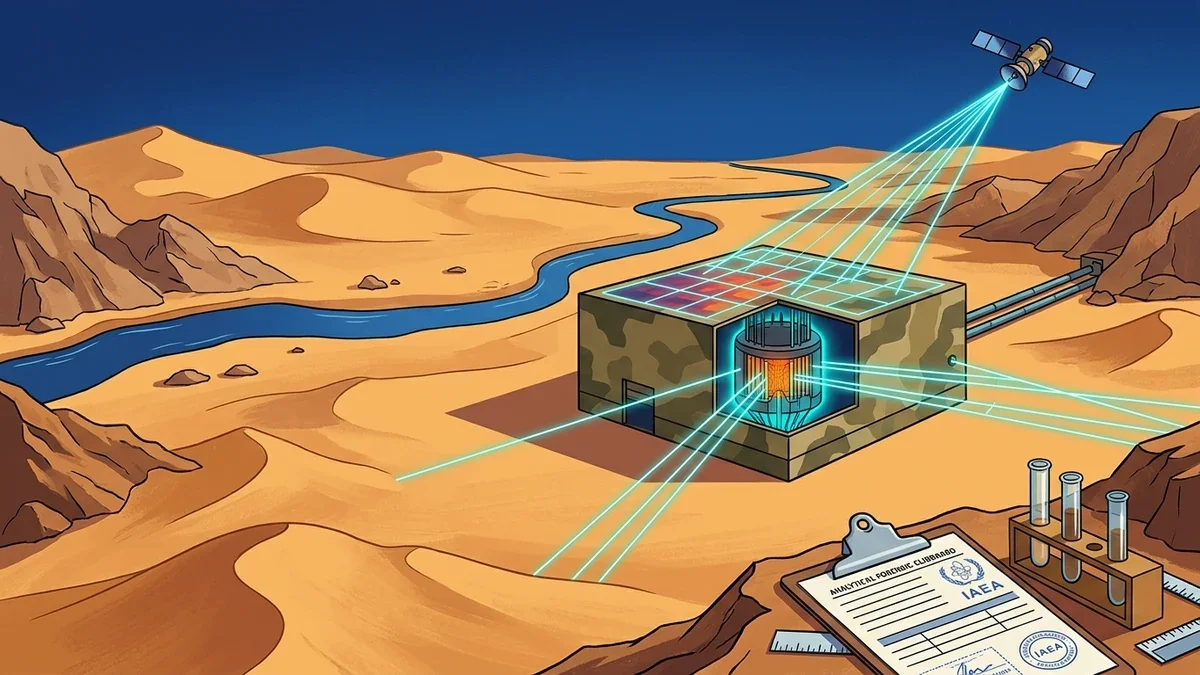
Unmasking a clandestine nuclear reactor is a multi-layered forensic discipline that combines commercial overhead satellite imagery, environmental radionuclide swipe sampling, thermal water intake modeling, and human intelligence. As new International Atomic Energy Agency (IAEA) findings confirm that Syria's undeclared facility at Deir el-Zour (Al Kibar) was an active gas-cooled graphite-moderated plutonium production reactor built with North Korean assistance, this guide explores the technical methodologies and intelligence tradecraft used to unmask covert nuclear weapons programs before operational criticality.
Executive Assessment & Epistemic Frame
Executive Assessment: The International Atomic Energy Agency's (IAEA) updated forensic findings regarding the historic Syrian nuclear site at Deir el-Zour provide a masterclass in covert nuclear detection methodology. Despite state-directed efforts to disguise the building as an ordinary warehouse, bulldoze the rubble, and encase the site in concrete following the 2007 strike, modern nuclear verification science—anchored by ultra-trace environmental swipe sampling and retrospective multi-spectral satellite imagery—leaves an indelible forensic fingerprint. Understanding these detection vectors is essential for analyzing modern proliferation risks across Iran, East Asia, and the Middle East.
Analytical Confidence: HIGH | IAEA Board of Governors official resolutions, isotopic mass-spectrometry lab verification, and commercial satellite time-series imagery confirm the facility was a custom-designed nuclear reactor.
Key Proliferation Risk: The transfer of complete turnkey reactor designs and specialized components from rogue nuclear states (e.g., North Korea's Yongbyon design) to secondary regional actors.
IAEA inspectors detected anthropogenically produced (man-made) uranium particles, nuclear-grade graphite particles, and specialized heavy-duty water intake plumbing at the destroyed Al Kibar site in Deir el-Zour.
The building dimensions, water flow capacity, and core layout matched North Korea's 25 MWt Yongbyon plutonium production reactor, optimized for weapons-grade fissile material creation.
Covert nuclear proliferation cannot be hidden from multi-sensor space and isotopic monitoring; however, diplomatic response latency often forces states into pre-emptive unilateral kinetic action.
1. The Four Technical Signatures of a Clandestine Nuclear Reactor
A state seeking a nuclear weapons capability through the plutonium route faces a fundamental engineering challenge: a plutonium production reactor requires massive physical infrastructure that cannot be easily hidden underground without revealing surface signatures. Intelligence agencies and IAEA safeguards inspectors monitor four primary technical pillars:
| Detection Pillar | Forensic Collection Vector | Physical / Chemical Signature | Deception Difficulty |
|---|---|---|---|
| 1. Thermodynamic Water Cooling | Thermal infrared satellite imaging, subsea/river intake pipeline analysis. | Thermal discharge plumes (+3°C to +8°C delta in river water) and high-volume pump houses. | Extremely High: Thermodynamics cannot be faked. |
| 2. Environmental Swipe Sampling | Cotton cloth swipe samples analyzed via Secondary Ion Mass Spectrometry (SIMS). | Microscopic dust particles of chemically processed anthropogenic uranium and plutonium isotopes. | Impossible to clean: Sub-micron particles persist for decades. |
| 3. Structural Geometry & IMINT | Commercial high-resolution electro-optical & Synthetic Aperture Radar (SAR). | Reinforced containment vaults, crane clearance heights, thick biological shielding. | Moderate: Disguiseable as civilian warehouse until internal layout is imaged. |
| 4. Noble Gas Emissions | Atmospheric Radionuclide Monitoring Stations (CTBTO network). | Radioactive Xenon (Xe-133, Xe-135) and Krypton-85 released during fuel rod reprocessing. | High (Only detectable once operational criticality is achieved). |
2. Case Study: Deconstructing the Deir el-Zour Covert Reactor
In 2001–2007, the Syrian government constructed a covert nuclear reactor in the desert near Deir el-Zour, situated approximately 1.5 kilometers from the Euphrates River. Codenamed Al Kibar, the facility was designed with North Korean technical cooperation to mirror the Yongbyon nuclear plant.
The Syrian deception strategy relied on architectural camouflage: workers built a square outer warehouse shell with an ordinary flat roof, concealing the tall cylindrical reactor containment vessel within. To ordinary satellite reconnaissance, the complex resembled a remote agricultural warehouse or water pumping facility.
The Unmasking Trigger: The Water Intake Flaw
The site was ultimately betrayed by its cooling infrastructure. A facility of that size without electrical power output or commercial smokestacks had heavy, buried water pipes drawing massive volumes from the Euphrates River—a water throughput far exceeding any civilian agricultural requirement. Human intelligence and Israeli photo reconnaissance confirmed North Korean nuclear engineers on-site, culminating in the pre-emptive airstrike on September 6, 2007 (Operation Orchard).
3. The Forensic Verification Battle: Why Soil Scraping Fails
Following the 2007 strike, the Syrian military executed an aggressive clean-up campaign: bulldozers leveled the site, the top layer of desert soil was excavated and removed, and a massive new concrete-and-steel building was erected over the foundations.
However, in nuclear forensics, you cannot erase the sub-micron scale:
The Nuclear Forensic Timeline: Deir el-Zour Case Study
Kinetic Interdiction (2007)
Facility destroyed prior to fuel loading; structural shell collapsed.
Site Sanitization
Bulldozers level site; topsoil removed; new concrete superstructure built.
IAEA Swipe Sampling (2008)
Cotton swipe samples collect microscopic sub-micron particles from surfaces.
Clean Lab Isotopic Analysis
Seibersdorf analytical laboratory isolates particles from natural soil background.
SIMS Mass Spectrometry
Secondary Ion Mass Spectrometry confirms chemically converted anthropogenic uranium.
Formal Attribution (2026)
Undeclared nuclear gas-cooled graphite reactor site definitively verified by IAEA.
When IAEA safeguards inspectors were granted access to the site in June 2008, cotton swipe samples collected from surviving environmental surfaces revealed particles of chemically modified, anthropogenic uranium that had undergone chemical conversion—a material that does not occur naturally in Syrian desert geology. Mass spectrometry analysis at the IAEA Safeguards Analytical Laboratory in Seibersdorf, Austria, proved that the particles were consistent with uranium fuel fabrication.
4. The Modern OSINT Revolution: Commercial Satellites & Proliferation Monitoring
In our foundational guide on Open-Source Intelligence & Verification, we noted that intelligence collection has shifted from closed state monopolies to open analytical ecosystems. Non-state researchers at think tanks (such as CSIS, ISIS, and the James Martin Center) now use commercial space architectures to monitor nuclear facilities:
- Synthetic Aperture Radar (SAR): Satellite constellations (e.g., Capella Space, ICEYE) image clandestine facilities through clouds and in total darkness, detecting millimeter-scale changes in concrete foundation depth.
- Multi-Spectral Thermal Infrared: Commercial sensors map wastewater heat plumes, determining whether an un-declared enrichment cascade or research reactor is operating at full power.
- Supply Chain Geolocation: Tracking specialized vacuum pumps, high-strength carbon fiber centrifuges, and maraging steel shipments through commercial maritime AIS and customs declarations.
5. Strategic Implications for 21st-Century Counter-Proliferation
- The Begin Doctrine Legacy: The Deir el-Zour strike established the precedent that states under perceived existential threat will strike covert nuclear sites unilaterally rather than wait for protracted diplomatic inspections.
- The Vulnerability of Turnkey Proliferation: Clandestine nuclear programs reliant on foreign state assistance (e.g., North Korea, A.Q. Khan network) inevitably leak through communication intercepts and logistics tracking.
- Safeguards Modernization: The IAEA's verification success demonstrates that environmental sampling remains the most potent tool in the non-proliferation regime, reinforcing the necessity of mandatory universal adherence to the IAEA Additional Protocol.
Expert Analysis — Shubham Saroj
"OSINT Analyst & Intelligence Researcher: Strategic intelligence assessments in the Regional Conflict Evaluations arena indicate shifting operational dynamics. The technical telemetry and incident vectors analyzed here reveal calculated adjustments by state and non-state actors to exploit structural vulnerabilities before defensive countermeasures can be deployed. Continuous technical and geospatial verification remains paramount."
Related Domain Analysis: Explore our coverage of Geopolitics & Strategy.
Topical Bibliography & References
- International Atomic Energy Agency (IAEA) (2026). "Implementation of the NPT Safeguards Agreement in the Syrian Arab Republic" IAEA Board of Governors Reports (GOV/2011/30 & 2026 Updates). [Source Link ↗]
- Center for Strategic and International Studies (CSIS) (2026). "Operation Orchard and the Deir el-Zour Reactor: Intelligence, Pre-emption, and Proliferation" CSIS Proliferation Prevention Program. [Source Link ↗]
- Royal United Services Institute (RUSI) (2026). "Satellite Imagery and Environmental Sampling: The Science of Nuclear Safeguards Verification" RUSI Occasional Papers. [Source Link ↗]
Key Takeaways
- Secret nuclear reactors cannot fully escape the laws of thermodynamics: they require continuous high-volume river/ocean water cooling and distinct pumping station infrastructure that can be detected via commercial satellite imagery.
- The 2007 Israeli airstrike (Operation Orchard) on the Al Kibar site demonstrated the 'Begin Doctrine'—pre-emptive destruction of an adversary's nuclear capability before fuel loading and radiological criticality.
- IAEA environmental swipe sampling in 2008 and recent inspections confirmed non-natural, anthropogenic uranium particles and graphite remnants on-site, providing undeniable scientific proof despite Syrian soil scraping and concrete burial.
- Modern open-source intelligence (OSINT) has democratized nuclear monitoring: commercial Synthetic Aperture Radar (SAR), multi-spectral optical satellites (Planet, Maxar), and thermal sensors now allow non-state analysts to track clandestine nuclear construction in near-real-time.
- Deterring covert proliferation requires integrating multi-sensor space architectures with robust multilateral IAEA Additional Protocol inspection mandates.
Need a Deeper Operational or Threat Assessment?
International Conflict Studies provides custom open-source intelligence dossiers, geopolitical risk modeling, and critical infrastructure threat diagnostics for enterprise and sovereign decision-makers.
Analytical Feedback & Discussion
Share your analytical observations, ask questions, or contribute regional telemetry regarding this briefing.