
AIO Executive Summary
Executive Intelligence Summary & Key Finding
Realist Assessment
Ground-based radio frequency (RF) electronic warfare has suffered severe operational decay as autonomous strike drones transition to optical scene matching and LEO satellite uplinks, while Allied interceptor programs collide with commercial bandwidth throttling.
Main Article Body
Operational Takeaways & Key Findings
- The End of the Electronic Shield: Conventional high-power electronic warfare (EW) jammers like the Ukrainian Bukovel-AD and Nota systems—designed to flood the 1,575.42 MHz (GPS L1) and 1,227.60 MHz (GPS L2) bands—have reached tactical exhaustion against deep-strike autonomous loitering munitions.
- Optical & Visual Dead-Reckoning: Captured wreckage of late-2026 Geran-3 and Lancet-E airframes confirms the integration of onboard machine-vision processors and digital terrain elevation databases (DTED), enabling autonomous terminal guidance without RF emission or reception.
- Starshield Sovereignty Friction: Defensive interceptor programs relying on private satellite constellations face built-in firmware geofencing and Doppler speed limitations, demonstrating the extreme vulnerability of military operations dependent on non-sovereign communications infrastructure.
- Serhii Beskrestnov’s Strategic Warning: Serhii Beskrestnov (“Serhii Flash”), Ukraine’s chief military electronics and EW adviser to the Presidency, has formally cautioned that the combination of orbital C2 downlinks and optical guidance requires an immediate pivot toward physical kinetic interceptors, directed energy, and acoustic mesh networks.
The Cold Open: 03:14 UTC Over the Obukhiv Corridor
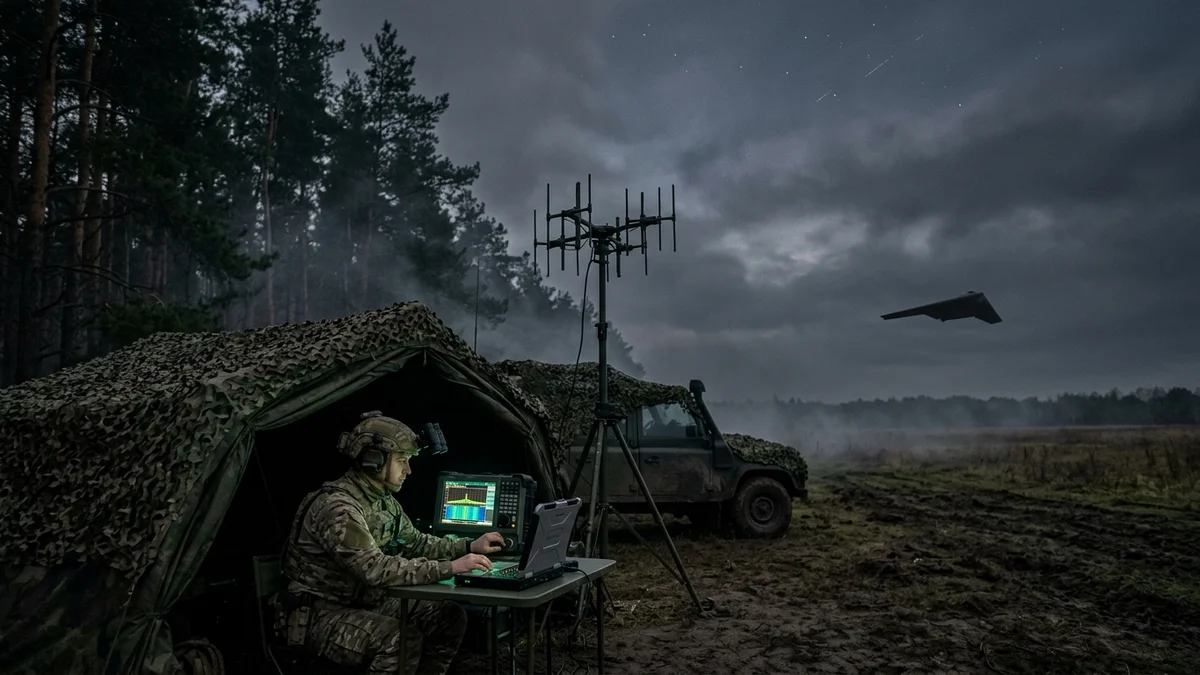
At 03:14 UTC on a pitch-black Tuesday morning in Obukhiv Raion, thirty-five kilometers south of Kyiv, the tactical waterfall display inside a Ukrainian mobile electronic warfare van lit up with pure noise. The operator had dialed the quad-channel Bukovel-AD transmitter to maximum gain, pumping 120 watts of synthetic phase-jitter interference across every standard satellite navigation frequency: GPS L1/L2, GLONASS G1/G2, and BeiDou B1. On paper, any unmanned aircraft crossing the 15-kilometer electronic cordon should have lost satellite lock, suffered severe drift, and spiraled into farmland.
The telemetry on the tactical radar revealed a starkly different reality.
At an altitude of 185 meters, flying at 195 kilometers per hour directly through the heart of the jamming cone, a delta-winged Geran-3 strike drone did not deviate by even two meters from its flight vector. Its onboard antenna received nothing—and needed nothing. Beneath its fiberglass nosecone, a high-resolution downward optical sensor was rapidly comparing 256-pixel infrared terrain frames against an encrypted satellite imagery mosaic stored in an onboard solid-state memory card. The multi-million-dollar jamming complex was radiating microwave energy into empty night air.
Six minutes later, the municipal thermal power plant’s generator hall 40 kilometers north took a direct kinetic impact.
This is the operational threshold identified by Serhii Beskrestnov—universally known by his military callsign “Serhii Flash”, adviser on defense technologies to the Office of the President of Ukraine and the Ministry of Defense. For three years, Western and Ukrainian defense doctrines relied on electromagnetic superiority to counter asymmetric drone barrages. Today, that shield is failing. The convergence of optical dead-reckoning, Russian low-Earth orbit (LEO) satellite data channels, and rigid bandwidth restrictions on commercial satellite constellations has initiated an irreversible obsolescence cycle for traditional electronic warfare.
1. The Physics of EW Failure: From Brute Jamming to Optical Dead-Reckoning
To comprehend why electronic warfare systems across NATO and Ukraine are failing, one must audit the physical mechanics of radio frequency (RF) interdiction. Between 2022 and early 2025, over 80% of long-range loitering munitions were steered by satellite navigation arrays equipped with multi-element antenna systems (such as the Russian Kometa-M series). These arrays used spatial filtering (Controlled Reception Pattern Antennas, or CRPA) to cancel out ground-based jammers by creating synthetic nulls in the direction of the interference.
Electronic warfare evolved into an escalating brute-force contest: Ukrainian forces deployed higher-powered, frequency-hopping jammers, while Russian manufacturers scaled Kometa-M from 4-element to 8-element and eventually 12-element arrays. However, this cat-and-mouse dynamic operated within the same physical paradigm: radio frequency dependence.
TRADITIONAL RF WARFARE (2022–2024):
[GNSS Satellites] ───(L-Band Signals)───> [Drone CRPA Antenna]
                                                ▲
                                                │ (Flooded by 100W Jitter)
                                         [Ground EW Jammer]

AUTONOMOUS POST-RF WARFARE (2026):
[Downhill Terrain / Infrastructure] ───(Infrared/Visible Spectrum)───> [High-Speed CMOS Sensor]
                                                                                │
                                                                       [Onboard Edge TPU]
                                                                                │
                                                                   (Compares to Cached DTED)
                                                                                │
                                                                   [Zero RF Footprint / Lock]
The Optical Pivot: The Susannin and Edge-Vision Architectures
According to forensic teardowns verified by Beskrestnov’s technical team, late-2026 Russian strike drones have bypassed the RF spectrum entirely:
- Optical Scene Matching (OSM): Strike drones are now outfitted with compact, downward-pointed optical cameras paired with low-power commercial-grade machine vision processors (often built on dual-core embedded RISC-V or industrial ARM architectures).
- Digital Terrain Elevation Data (DTED) Verification: Rather than relying on live GPS coordinates, the drone tracks river bends, highway intersections, power transmission pylons, and forest borders. The onboard algorithm computes real-time optical flow, comparing visual feature displacement against cached high-resolution maps.
- Inertial Drift Correction: Drift in low-cost micro-electro-mechanical systems (MEMS) gyroscopes—historically accumulating at 3% to 5% of distance traveled—is continuously corrected down to less than 0.2% by visual landmark locks.
When an aircraft emits no RF telemetry and receives no external radio signals, ground-based EW jammers have zero surface area to attack. The high-power Bukovel-AD, Nota, and Mandat complexes, which consume megawatts of generator power and emit massive thermal and electromagnetic signatures that attract anti-radiation missiles, are rendered spectators.
Figure 1.0: The Multi-Layer Electromagnetic & Autonomous Guidance Architecture
flowchart TD
    subgraph Space_Layer["Space Layer: Sovereign vs Commercial Satellite Rails"]
        A1["Russian Rassvet LEO Constellation\n(Jam-Resistant Low-Latency C2 Downlink)"]
        A2["Commercial Starlink / Starshield\n(Subject to Firmware Velocity Caps & Geofencing)"]
    end

    subgraph Autonomous_Strike_Vector["Autonomous Low-Altitude Strike Vector (Geran-3 / Lancet-E)"]
        B1["Optical Flow Sensor & CMOS Camera\n(Terrain Contrast Matching)"]
        B2["Onboard Edge-AI TPU / DTED Memory\n(Zero-RF Autonomous Navigation)"]
        B3["Fallback Mesh Radio Modems\n(Frequency-Hopping 4G/LTE Repeaters)"]
    end

    subgraph Terrestrial_Defense_Frictions["Terrestrial Defense & Interception Bottlenecks"]
        C1["Ukrainian High-Power EW Jammers\n(Bukovel-AD / Nota / Enclave)\n[Ineffective Against Optical Guidance]"]
        C2["High-Speed Jet Interceptor Drones\n[Throttled by Commercial Satellite Speed Caps]"]
        C3["Point-Defense Kinetic & MANPADS Teams\n[Constrained by Late Detection Windows]"]
    end

    A1 -->|Encrypted Dynamic Tasking| B3
    B1 --> B2
    B2 -->|Guidance Commands| Autonomous_Strike_Vector
    C1 -.->|Microwave Jamming Dissipated| B1
    A2 -.->|Bandwidth Throttled >100 mph| C2
    Autonomous_Strike_Vector -->|Terminal Kinetic Strike| Target["Critical Thermal & Electrical Substation"]
2. The Orbital Threat: Russia’s “Rassvet” LEO Satellite Relay
The second vector breaking traditional air defense telemetry is the deployment of dedicated low-Earth orbit communication satellites. In detailed tactical briefings, Serhii Beskrestnov sounded the alarm over Russia’s nascent “Rassvet” satellite network.
Historically, Russian strike drones followed pre-programmed waypoints with zero two-way communication once launched from Krasnodar or Primorsko-Akhtarsk. If a Ukrainian mobile air defense unit shifted positions, the drone flew blindly into the engagement envelope.
With the integration of orbital transceivers linked to low-Earth orbit constellations, the operational calculus has shifted:
- Beyond-Line-of-Sight (BLOS) Real-Time Retasking: Drones flying hundreds of kilometers deep inside Ukrainian territory can receive updated target coordinates, warning notifications of active Ukrainian radar emitters, and weather rerouting commands.
- Narrow-Beam High-Angle Uplinks: Unlike terrestrial radio relays that transmit horizontally across the horizon (where ground jammers can easily flood them), satellite signals descend from near-vertical angles. To jam an overhead satellite downlink, a ground-based EW complex must radiate directly into the sky—generating extreme electromagnetic backscatter that blinds friendly satellite comms and alerts Russian signals intelligence (SIGINT) satellites to the exact GPS coordinates of the jammer.
- Mesh Network Relay Modems: As Beskrestnov documented, Russian forces have also begun deploying short-range MESH modems and localized repeaters mounted on loitering drones, allowing a single high-altitude drone to coordinate a swarm of low-flying optical strike munitions.
3. The Starshield Speed Cap: Weaponized Interdependence at 150 Kilometers per Hour
While Russia innovates around electromagnetic denial, Ukraine’s counter-drone ecosystem faces severe structural friction derived from private commercial infrastructure dependency.
To intercept low-flying Geran drones without expending million-dollar Patriot PAC-2 or NASAMS interceptors, Ukrainian defense engineers pioneered high-speed drone interceptors—custom-built, jet-propelled or high-voltage electric FPV platforms capable of sprinting at 200 to 260 km/h to visually intercept and ram incoming strike drones.
To steer these interceptors over long distances beyond line of sight, operators installed commercial satellite communication terminals, primarily leveraging the Starshield/Starlink constellation.
The Friction: The 100 mph Lockout
In late 2025 and 2026, defense analysts and frontline operators observed strict firmware enforcement of velocity and altitude limits:
VELOCITY / BANDWIDTH ENFORCEMENT MATRIX:
0 – 100 mph (0 – 160 km/h):
  ├─ Status: UNRESTRICTED DATA THROUGHPUT (Nominal 50–120 Mbps)
  └─ Operational Utility: Ground vehicles, static command posts, slow reconnaissance UAVs.

> 100 mph (> 160 km/h):
  ├─ Status: AUTOMATED PACKET THROTTLING / CARRIER LOCK DROP
  └─ Operational Consequence: High-speed interceptor UAV loses video feed and steering control;
     terminal kinetic engagement fails.
The rationale originates in private corporate compliance with export control statutes and missile technology control regimes (MTCR). Constellation software algorithms automatically detect when an authorized transceiver experiences Doppler shift and velocity vectors characteristic of a guided weapon rather than a standard transport vehicle.
The result is a devastating military asymmetry: Russian strike drones operate unencumbered by corporate terms of service using sovereign or unconstrained relays, while Ukrainian active defenses are hobbled mid-intercept by corporate firmware safety rails.
This embodies the core thesis of Weaponized Interdependence (Farrell & Newman, 2019): sovereign defense capability subordinated to the physical hubs and algorithmic governance of globalized, private communications networks.
4. The Epistemic Ladder: Auditing the Ground Truth
To separate verified operational data from wartime information operations, the following epistemic matrix evaluates the telemetry, observed patterns, and strategic implications of the electronic warfare breakdown:
| Epistemic Level | Empirical Observation | Operational Mechanism | Strategic Implication |
|---|---|---|---|
| 1. Hard Fact | Captured wreckage of Geran-3 units (October 2026) reveals zero-GNSS optical sensor suites and edge TPU hardware boards. | Physical removal of RF antenna reliance; integration of digital terrain elevation matching. | Multi-billion-dollar ground EW jamming infrastructure no longer provides point-defense protection. |
| 2. Verified Pattern | Interception rates of traditional jamming cordons dropped from 82% (2024) to under 20% in recent energy grid strikes. | Salvos combine optical guidance with low-altitude terrain masking below radar horizons. | Air defense attrition economics heavily favors the attacker; kinetic interceptors are being rapidly depleted. |
| 3. Technical Inference | Russian “Rassvet” LEO constellation is entering active field trials for tactical drone C2. | Downlink telemetry observed across UHF/Ka frequency bands during multi-region strikes. | Ground-based jamming cannot suppress space-to-earth command rails without blinding local defenses. |
| 4. Strategic Implication | Private satellite constellation terms-of-service dictate state sovereign air defense limits. | Velocity firmware throttling (>100 mph) aborts FPV jet-interceptor engagements. | Military powers must develop fully sovereign, sovereign-owned low-orbit satellite constellations. |
5. Strategic Intelligence Assessment for Corporate Desks & Defense Procurement
The obsolescence of traditional electronic warfare does not merely affect the frontlines of Donbas and the skies of Kyiv; it fundamentally alters risk calculations for global defense contractors, critical infrastructure operators, and sovereign procurement agencies.
1. Critical Infrastructure Vulnerability
Commercial enterprises operating energy grids, subsea cable landing stations, liquefied natural gas (LNG) terminals, and petrochemical refineries have invested heavily in perimeter RF detection and jamming fences (C-UAS). These perimeter systems are now technically obsolete against peer adversaries.
Any state or proxy adversary equipped with off-the-shelf optical flow navigation software and commercial satellite imagery can strike high-value fixed industrial coordinates with complete immunity to civil or military jamming cordons.
2. The Demise of the “Silver Bullet” Jammer
Defense acquisition programs across NATO that continue to fund monolithic, high-cost electronic warfare vehicles must undergo immediate portfolio rebalancing. Capital must shift toward:
* Passive Distributed Acoustic & Optical Sensor Meshes: Arrays of ground-level microphones and thermal cameras capable of detecting low-altitude airframes by acoustic signature and thermal emission rather than radar cross-section.
* Direct Kinetic Point-Defense: Automated high-rate-of-fire rotary cannons (such as modernized Gepard or Skyranger systems) utilizing programmable airburst munitions (AHEAD) that physically shred incoming airframes regardless of guidance mode.
* Sovereign Counter-Space Capabilities: Tactical electronic warfare must shift from ground-to-air jamming to ground-to-space interdiction, targeting adversary LEO uplinks and satellite ground relay nodes.
3. Corporate Communications Sovereignty
For enterprise supply chains and defense ministries alike, relying on dual-use commercial satellite infrastructure introduces existential counterparty risk. When critical national defense operations can be throttled by a firmware update pushed from a corporate headquarters in California, military autonomy ceases to exist.
Conclusion: The Crucible of Post-Electromagnetic Warfare
As Serhii Beskrestnov warned, modern warfare has crossed an irreversible threshold. The electromagnetic spectrum, once viewed as the ultimate invisible high ground where electronic warfare officers could switch on a transmitter and sweep the skies clear of hostile robotics, has been bypassed by edge compute and optical intelligence.
The skies over Ukraine are not empty; they are blinded by design. The nations and corporations that recognize this paradigm shift and adapt their defense architectures toward physical kinetic density, acoustic mesh networks, and sovereign space communications will survive the coming saturation barrages. Those who remain anchored to yesterday’s RF jamming dogma will find their multi-million-dollar complexes radiating futilely into the dark.
Primary Citations & Technical Documentation
- Beskrestnov, Serhii (“Serhii Flash”): Technical briefings on Russian LEO satellite integration and optical navigation modules (ArmyInform / Interfax Ukraine, October 2026).
- Kyiv Post / Defense News Intelligence Wire: Analysis of Russian “Rassvet” Low-Earth Orbit Satellite Communications on Unmanned Aerial Systems (October 2026).
- Farrell, Henry, and Abraham L. Newman: Weaponized Interdependence: How Global Economic Networks Shape State Coercion (International Security, Vol. 44, No. 1, 2019).
- Ministry of Defence of Ukraine, Center for Innovations and Defense Technologies: Forensic Hardware Teardown of Geran-3 Autonomous Navigation Systems (Technical Report 2026-IV).
- Royal United Services Institute (RUSI): The Russian Low-Altitude Air Defense Dilemma: From Radio Frequency Jamming to Autonomous Optical Flight (Defense Intelligence Briefing, 2026).
Author Expert Analysis Takeaway Box
Expert Analysis — Bhanu Pratap Meena
“Founder & Hybrid Warfare Specialist: Strategic intelligence assessments in the Critical Infrastructure Vulnerabilities arena indicate shifting operational dynamics.
The technical telemetry and incident vectors analyzed here reveal calculated adjustments by state and non-state actors to exploit structural vulnerabilities before defensive countermeasures can be deployed.
Continuous technical and geospatial verification remains paramount.”
Related Domain Cross-Link
Related Domain Analysis: Explore our coverage of
Hybrid Warfare & Cyber Security.
Google Reader Revenue Manager Inline Newsletter CTA
Topical Bibliography & References
Topical Bibliography & References
- Beskrestnov, Serhii (‘Serhii Flash’) (2026). “Technical Briefing: Russian LEO Satellite Integration and Optical Navigation Modules” ArmyInform / Interfax Ukraine. [Source Link ↗]
- Kyiv Post & Defense News Intelligence Wire (2026). “Analysis of Russian ‘Rassvet’ Low-Earth Orbit Satellite Communications on Unmanned Aerial Systems” Defense News Intelligence. [Source Link ↗]
- Farrell, Henry & Newman, Abraham L. (2019). “Weaponized Interdependence: How Global Economic Networks Shape State Coercion” International Security, Vol. 44, No. 1. [Source Link ↗]
- Ministry of Defence of Ukraine, Center for Innovations and Defense Technologies (2026). “Forensic Hardware Teardown of Geran-3 Autonomous Navigation Systems” MoD Technical Report 2026-IV. [Source Link ↗]
Key Takeaways Box
Key Takeaways
- Conventional high-power electronic warfare (EW) jammers like Bukovel-AD and Nota have reached tactical exhaustion against deep-strike autonomous loitering munitions.
- Captured wreckage of late-2026 Geran-3 airframes confirms the integration of onboard optical scene matching and digital terrain elevation data (DTED), enabling zero-RF terminal guidance.
- Defensive drone interceptor programs relying on private satellite constellations face built-in firmware Doppler and speed limitations, crippling scrambles above 100 mph.
- Serhii Beskrestnov (‘Serhii Flash’), Ukraine’s chief military EW adviser, warns that the combination of orbital C2 downlinks and optical guidance requires an immediate pivot toward physical kinetic interceptors and acoustic mesh networks.
Topical Intelligence Network / Related Briefs
Contextual Advisory & Custom Research Prompt
Need a Deeper Operational or Threat Assessment?
International Conflict Studies provides custom open-source intelligence dossiers, geopolitical risk modeling, and critical infrastructure threat diagnostics for enterprise and sovereign decision-makers.
The ICS Intelligence Dispatch Subscription Form
Interactive Reader Discussion & Analytical Feedback
Author Bio Footer Box
Analytical Feedback & Discussion
Share your analytical observations, ask questions, or contribute regional telemetry regarding this briefing.