More Than 200 Victims of Medusa Ransomware Identified Over Last Year, CISA and Five Eyes Warn
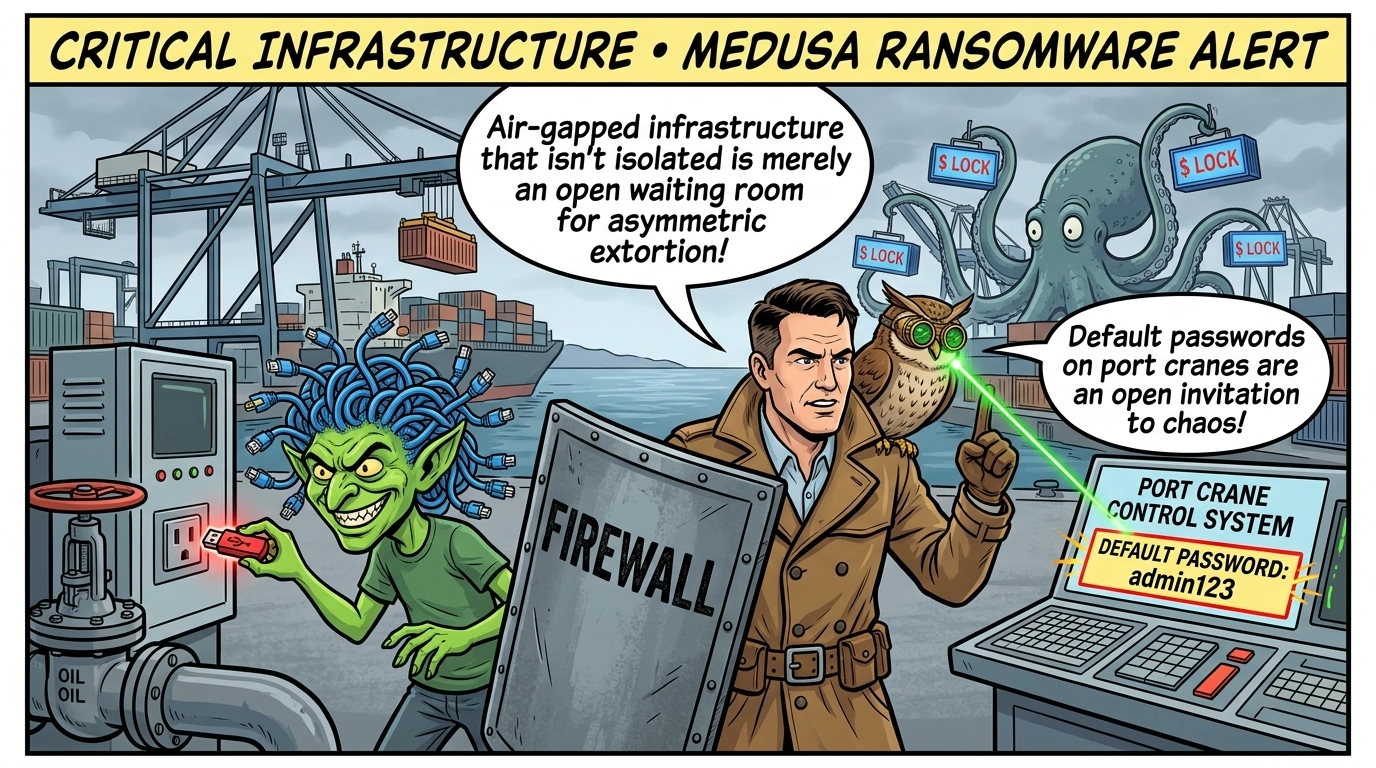
The CISA-Five Eyes joint advisory cataloging over 200 Medusa ransomware intrusions highlights the accelerating convergence of cybercrime syndicates and state-aligned grey-zone sabotage—specifically targeting the unsegmented IT/OT perimeter of regional water districts, maritime terminals, and energy substations.
Initial Access Tradecraft: Exploiting the Edge Device Perimeter
The joint technical advisory released by the U.S. Cybersecurity and Infrastructure Security Agency (CISA), the Federal Bureau of Investigation (FBI), and allied Five Eyes cyber agencies details the operational methodology of the Medusa ransomware group (distinct from the legacy MedusaLocker strain). Operating as a Ransomware-as-a-Service (RaaS) model, Medusa coordinates an affiliate network that has compromised over 200 critical infrastructure and manufacturing entities across North America, Europe, and Australasia.
Technical telemetry confirms that Medusa affiliates bypass perimeter defenses not through novel zero-days, but by exploiting unpatched edge-device firmware and credential stuffing against legacy Remote Desktop Protocol (RDP) gateways. Primary initial access vectors include known vulnerabilities in Fortinet FortiOS SSL-VPN appliances (such as CVE-2023-27997), SonicWall SMA gateways, and public-facing Citrix ADC endpoints. Once inside the perimeter, operators establish persistence within minutes through obfuscated PowerShell execution and web shell injection.
| MITRE Stage | Technique ID | Observed Medusa Tool / Tactic | Target Environment | Recommended Countermeasure |
|---|---|---|---|---|
| Initial Access | T1190 / T1133 | Exploitation of external VPN & RDP gateways | Enterprise DMZ perimeter | Mandatory FIDO2 hardware MFA |
| Lateral Movement | T1021.002 / T1570 | PsExec, SMB lateral spread, SharpHound AD scan | Corporate Active Directory domain | Disable SMBv1; isolate Tier-0 domain admins |
| Defense Evasion | T1562.001 | Batch scripts killing EDR, deleting Shadow Copies | Local endpoints & backup servers | Immutable air-gapped WORM backups |
| Exfiltration | T1567.002 | Rclone multi-thread transfer to Mega / AWS S3 | Network egress traffic | Deep-packet inspection & cloud storage egress blocks |
Execution Chain: Living-off-the-Land and EDR Termination
Once network footholds are secured, Medusa operators deploy Living-off-the-Land Binaries (LOLBins) to navigate internal subnets without triggering signature-based antivirus alerts. Operators execute Active Directory reconnaissance using modified PowerShell scripts and open-source enumeration tools (such as Advanced IP Scanner and PingCastle).
Prior to executing the cryptographic encryption routine, the malware executes hardcoded batch commands that methodically blind local administrative monitoring:
- Volume Shadow Copy Deletion: Executing
vssadmin.exe delete shadows /all /quietandwbadmin.exe delete catalog -quiet, completely eliminating local automated rollback capabilities. - Service Termination: Systematically stopping database and backup background daemons (including Microsoft SQL Server, MySQL, Veeam, and Veritas Backup Exec) to release file locks on high-value business stores.
- Security Daemon Neutralization: Tampering with endpoint detection and response (EDR) agents via malicious kernel-mode drivers (Bring Your Own Vulnerable Driver - BYOVD attacks) to silence telemetry feeds before deploying the AES-256 and RSA-2048 hybrid encryption payload.
Double Extortion and the Sovereign Threat Interface
Medusa pioneered an aggressive double-extortion media apparatus. In addition to encrypting on-premises storage arrays, the group exfiltrates hundreds of gigabytes of proprietary schematics, employee credentials, and engineering blueprints using multi-threaded Rclone utilities. Exfiltrated data is published to the "Medusa Blog" hosted on the Tor darknet, featuring countdown timers and dynamic public auctions allowing competitors or hostile foreign intelligence services to purchase sensitive infrastructure topology data.
From a hybrid warfare standpoint, the line between purely financial cyber extortion and state-sanctioned asymmetric harassment has eroded. Sovereign states under international financial sanctions increasingly utilize ransomware cartels as both revenue-generating proxies and plausible deniability reconnaissance tools. When a regional water treatment plant or port terminal is shut down by Medusa, the physical supply-chain disruption mirrors a kinetic stand-off strike—at a fraction of the cost and with zero kinetic attribution.
Key Takeaways
- Verifiable data in the critical infrastructure vulnerabilities domain points to structural realignment.
- Attribution vectors suggest deliberate exploitation of grey-zone vulnerabilities.
- Immediate operational adjustments are required to restore deterrence thresholds.
- Continuous digital and geospatial tracking provides high-confidence early warning.
Need a Deeper Operational or Threat Assessment?
International Conflict Studies provides custom open-source intelligence dossiers, geopolitical risk modeling, and critical infrastructure threat diagnostics for enterprise and sovereign decision-makers.
Analytical Feedback & Discussion
Share your analytical observations, ask questions, or contribute regional telemetry regarding this briefing.