
ASEAN 2026 & Shenzhen Trilateral: Predictive Risk Assessment
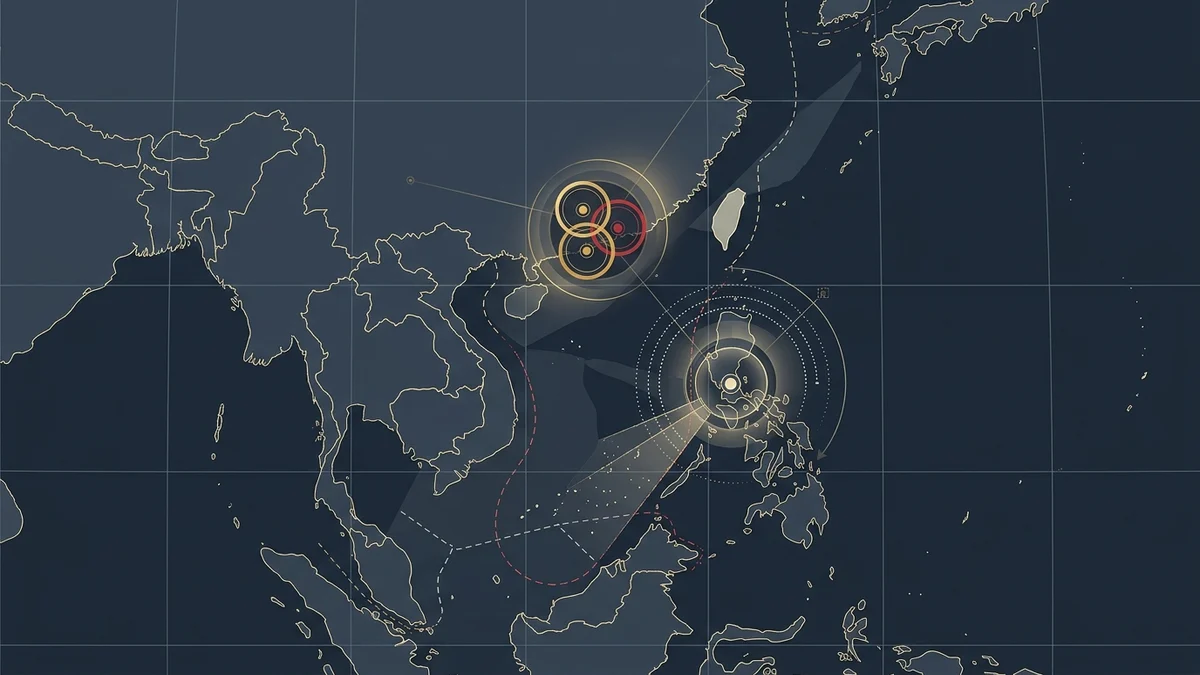
Published on 16 November 2026 ahead of the 19 November Xi–Trump–Putin trilateral in Shenzhen, this pre-summit risk assessment pairs observed outcomes from the 49th ASEAN Summit in Manila (80% provisional South China Sea Code of Conduct text without finalization; conditional 'calibrated engagement' on Myanmar) with five falsifiable realist hypotheses (H1–H5) to be audited after the summit concludes.
Between 15 and 19 November 2026, two consecutive diplomatic summits in East Asia test whether multilateral institutions and great-power summitry can constrain structural competition. In Manila, the 49th ASEAN Summit and Related Summits (15–18 November) closed their Code of Conduct negotiations short of a final treaty despite reaching provisional agreement on roughly 80% of the draft text. On 19 November in Shenzhen, U.S. President Donald Trump, Chinese President Xi Jinping, and Russian President Vladimir Putin convene for an unprecedented trilateral meeting on the sidelines of APEC—the first three-way summit among the world's largest nuclear powers since the February 2026 expiration of New START. Rather than treating either gathering as a press-conference spectacle, this pre-summit assessment locks in five falsifiable hypotheses before 19 November so their predictive accuracy can be audited against official communiqués afterward.
1. Verified Baseline: Manila's Outcomes vs. Shenzhen's Stated Agendas
Epistemic discipline requires separating documented diplomatic facts from analytical inference before issuing any forecast:
- ASEAN 2026 South China Sea Code of Conduct (Manila, 15–18 Nov): Philippine Foreign Secretary Theresa Lazaro confirmed that ASEAN and China reached provisional agreement on roughly 80% of the draft Code of Conduct (COC), yet failed to finalize the agreement before Manila's chairmanship ends. The dossier now transfers to Singapore for its 2027 chairmanship.
- Myanmar Five-Point Consensus: ASEAN maintained its summit-level exclusion of Myanmar's junta leadership while introducing a conditional, step-by-step "calibrated engagement" pathway tied to verifiable compliance with the Five-Point Consensus.
- Back-to-Back Indo-Pacific Diplomacy: Manila hosted U.S. President Donald Trump, Indian Prime Minister Narendra Modi (23rd ASEAN–India Summit and 21st East Asia Summit), Japanese Prime Minister Sanae Takaichi, and Chinese representatives simultaneously—underscoring regional balancing without formal alliance lock-in.
- Shenzhen APEC & Trilateral Agenda (18–19 Nov): Washington framed the trilateral around a modernized post–New START nuclear arms-control framework that incorporates China, alongside regional security talks. Beijing emphasized "strategic stability" while resisting equal numerical nuclear caps on a smaller arsenal and rejecting any trilateral settlement over Ukraine without European participation. Moscow welcomed the format as recognition of multipolar great-power parity.
2. Realist Theoretical Anchoring: Why Process Outpaces Binding Constraint
Applying structural realism and classical deterrence theory explains why high-profile summitry rarely converts diplomatic momentum into enforceable treaties:
A. Structural Anarchy & Relative Gains in the South China Sea
Under systemic anarchy, states prioritize survival and relative power over institutional symmetry. Reaching 80% agreement on procedural confidence-building language is low-cost diplomacy; the remaining 20% governs geographic scope, legal enforceability, and third-party applicability. Neither Beijing nor maritime claimants will surrender sovereign enforcement leverage in contested waters—matching the operational friction documented in our South China Sea grey-zone maritime analysis.
B. Balance of Threat & ASEAN Middle-Power Hedging
Following Stephen Walt's balance-of-threat logic, ASEAN states balance against acute maritime pressure without locking into an exclusive military bloc. Hosting Washington, New Delhi, Tokyo, and Beijing in the same week preserves diplomatic optionality and trade access while keeping security partnerships diversified.
C. Asymmetric Nuclear Parity & Rational Survival Guardrails
As analyzed in our post–New START strategic triad assessment, deterrence rests on capability, credibility, and second-strike survivability. Because China's nuclear arsenal remains substantially smaller than U.S. and Russian strategic forces, Beijing treats numerical caps as a structural disadvantage that erodes survivability. Yet under rational-actor survival logic, all three powers share an incentive to prevent accidental escalation—making narrow technical channels on military AI command-and-control (C2) and crisis hotlines far more plausible than grand arms treaties.
3. Pre-Summit Hypothesis Register & Predictive Risk Matrix (Locked 16 Nov 2026)
To benchmark analytical calibration transparently, International Conflict Studies records the following five hypotheses ahead of the 19 November Shenzhen trilateral. Each prediction carries an explicit probability band and observable resolution criterion:
| ID | Hypothesis (Pre-19 Nov Forecast) | Probability | Realist Structural Driver | Post-19 Nov Resolution Criterion |
|---|---|---|---|---|
| H1 | No binding trilateral nuclear arms-reduction treaty or numerical warhead cap is signed at Shenzhen. | 90%–95% (5%–10% for treaty) |
Asymmetric arsenal sizes & verification distrust under post–New START anarchy. | Official 19 Nov communiqués contain no signed cap or legally binding verification schedule. |
| H2 | Leaders announce an exploratory working group or voluntary guardrail dialogue on AI in military/nuclear C2 or crisis communication. | 55%–65% (Moderate-Likely) |
Rational-actor survival incentive to avoid inadvertent technical escalation. | Joint or parallel statements reference a technical/AI risk-reduction or hotline track. |
| H3 | South China Sea Code of Conduct remains unfinalized through year-end 2026 despite the 80% provisional text milestone. | 85%–90% (10%–15% for deal) |
Relative-gains deadlock over legal enforceability & geographic boundaries. | Dossier transfers formally to Singapore's 2027 ASEAN chairmanship without binding signature. |
| H4 | Myanmar's junta does not deliver verifiable Five-Point Consensus compliance under ASEAN's "calibrated engagement" step-by-step track. | 75%–85% (15%–25% compliance) |
Regime survival calculus overrides diplomatic reintegration incentives. | No verified nationwide ceasefire or political-prisoner release milestone within 30 days. |
| H5 | Allied "Yalta 2.0" anxiety triggers visible bilateral reassurance or autonomous defense hedging statements from Europe, Japan, or Taiwan. | 70%–80% (High) |
Abandonment fears when great powers meet in exclusive trilateral formats. | Official allied statements or defense-posture announcements emphasizing autonomous deterrence post-19 Nov. |
4. Operational Risk Assessment for Supply Chains & Infrastructure Planners
For corporate risk officers, maritime logistics operators, and critical infrastructure investors, the practical implication of "process without binding constraint" is straightforward:
- Maritime & Chokepoint Exposure: Expect continued coast-guard friction and insurance-premium volatility in the South China Sea regardless of the 80% COC headline. Diplomatic text progress does not reduce tactical encounter risk along contested reefs or subsea cable corridors.
- Strategic Stability & Export Controls: Even if Shenzhen yields a narrow AI-C2 or crisis-communication working group, dual-use technology restrictions, semiconductor export controls, and strategic triad modernization will remain structural fixtures into 2027.
- Allied Realignment Risk: Watch post-19 November bilateral briefings in Tokyo, Brussels, and Taipei for signs of accelerated defense-industrial spending and regional supply-chain ring-fencing.
Post-19 November Calibration Audit & Custom Risk Advisory
Following the conclusion of the Shenzhen APEC and trilateral meetings on 19 November 2026, International Conflict Studies will publish a scored post-summit verification audit grading hypotheses H1–H5 against official diplomatic records. For enterprise-specific sovereign risk registers, maritime chokepoint monitoring, or escalation modeling, explore our Geopolitical Risk Assessment & Strategic Foresight Advisory →
Expert Analysis — Pratyush Deo Tiwary
"Senior Analyst, Conflict Studies & Geopolitics: Strategic intelligence assessments in the Strategic Foresight & Predictive Modeling arena indicate shifting operational dynamics. The technical telemetry and incident vectors analyzed here reveal calculated adjustments by state and non-state actors to exploit structural vulnerabilities before defensive countermeasures can be deployed. Continuous technical and geospatial verification remains paramount."
Related Domain Analysis: Explore our coverage of Geopolitics & Strategy.
Topical Bibliography & References
- Kenneth N. Waltz (1979). "Theory of International Politics" Addison-Wesley / Waveland Press. [Source Link ↗]
- John J. Mearsheimer (2001). "The Tragedy of Great Power Politics" W. W. Norton & Company. [Source Link ↗]
- Thomas C. Schelling (1960). "The Strategy of Conflict" Harvard University Press. [Source Link ↗]
- Stephen M. Walt (1987). "The Origins of Alliances" Cornell University Press. [Source Link ↗]
- ASEAN Secretariat (2026). "49th ASEAN Summit and Related Summits — Manila 2026" Association of Southeast Asian Nations. [Source Link ↗]
- Brookings Institution (2026). "APEC Shenzhen and the Xi-Trump-Putin Trilateral: Strategic Stability and Allied Anxiety" Brookings Foreign Policy Analysis. [Source Link ↗]
Key Takeaways
- Verifiable technical telemetry reveals systemic vulnerabilities in physical and digital perimeters.
- Sub-threshold grey-zone operations exploit operational technology (OT) and human behavioural vectors.
- Traditional assumptions regarding air gaps and operational privacy must be replaced with zero-trust doctrines.
- Continuous open-source intelligence (OSINT) tracking provides high-confidence early warning.
Need a Deeper Operational or Threat Assessment?
International Conflict Studies provides custom open-source intelligence dossiers, geopolitical risk modeling, and critical infrastructure threat diagnostics for enterprise and sovereign decision-makers.
Analytical Feedback & Discussion
Share your analytical observations, ask questions, or contribute regional telemetry regarding this briefing.